Showing posts with label autumn. Show all posts

Monday, November 29, 2010

Spaghetti Squash with Sage


I intended to post this recipe prior to Thanksgiving, but alas, I got wrapped up preparing the big feast.  While it would be perfect on Turkey Day for the nice presentation, this roasted spaghetti squash, adapted from Andrew Carmellini's Urban Italian, is simple enough to have as a side dish for a weeknight meal.  Carmellini calls for walnuts, but they didn't do too much for me; to add a little crunch I would try mixing in some toasted squash or pumpkin seeds.  Carmellini also suggests adding grated Parmesan cheese to the squash, so if you have cheese on hand, feel free to use it.

Roasted Spagghetti Squash with Sage and Squash Seeds
Adapted from Urban Italian

Ingredients:
  • 1 spaghetti squash
  • salt and pepper
  • 5 tbsp butter, divided in 1 tbsp pieces
  • 15 fresh sage leaved
Directions:
  1. Preheat the oven to 400F.
  2. Slice the squash in half lengthwise.  
  3. Use a spoon to scrape out the seeds and set the seeds aside.  
  4. Season both halves of the squash with salt and pepper.  
  5. Place 1 tbsp butter and 2 sage leaves in the cavity of each squash half and roast on a baking sheet until the squash is completely tender, about one hour.
  6. Use a fork to to scrape out the meat from each squash half.  Reserve the squash skins and put the strands of squash in a bowl.  
  7. Heat the remaining 3 tbsp butter in a medium sauce pan over medium heat.  
  8. Add the squash seeds to the sauce pan and cook, stirring occasionally, until they are golden, 3 to 5 minutes.
  9. Add the remaining sage leaves to the sauce pan and cook until they are fragrant, about 1 minutes.
  10. Stir the squash into the pan and cook for 2 minutes, stirring constantly to mix all of the ingredients together.  Season with salt and pepper to taste.
  11. Remove the squash from the pan and serve it in one of the squash skins.

Tuesday, November 23, 2010

Sauteed Brussels Sprouts with Bacon, Lemon, and Chili Flakes


You still have time to finish your Thanksgiving menu.  Here's a simple side that sure to please even the Brussels sprout haters.  Between the heat of the chili flakes, the acidity of the lemon, the sweetness of the bacon and Brussels sprouts, and the fresh flavor of the mint, I love the flavor contrasts in this dish.

Sauteed Brussels Sports with Bacon, Lemon, Chili Flakes, and Mint
Serves 2 to 3
 
Ingredients:
  • 3 slices of bacon, diced
  • 12 oz. Brussels sprouts, cut in half if large
  • juice from half a lemon
  • 1/4 tsp dried red chili flakes
  • salt and pepper, to taste
  • 1/4 cup mint leaves, finely chopped

Directions:
  1. Heat a large skillet over medium-high heat.  Add the bacon and cook, stirring occasionally, until it is crisp. about 3 minutes.  Remove the bacon from the pan with a slotted spoon.
  2. Add the Brussels sprouts to the skillet and season with salt and pepper.  Cook the Brussels sprouts, stirring occasionally, until they brown on all sides, 7 to 10 minutes.  
  3. Add the chili flakes to the pan and reduce the heat to medium and continue to cook until the Brussels sprouts soften, another 10 to 15 minutes.
  4. Reduce the heat to low.  Pour in the lemon juice and season the Brussels sprouts with salt and pepper to taste.  
  5. Put the Brussels sprouts in a bowl and top with the reserved bacon and the mint.  Serve immediately.
 

Thursday, November 18, 2010

Cranberry-Apple Crisp with a Semolina Topping


I'm very much a traditionalist when it comes to Thanksgiving desserts.  All other times of the year, I love creative desserts, but at Thanksgiving, all I want is pie, preferably of the pumpkin or pecan variety.  After tasting this cranberry-apple crisp I was surprised to find myself thinking that it would be a perfect way to end a Turkey Day feast.  This crisp has all of the familiar Thanksgiving flavors, but it goes the extra mile with plenty of orange and lemon zest and a hint of anise in the topping.  It is sure to please both the traditionalists and those who want a bit more creativity in their desserts.


The recipe comes from one of my favorite food blogs, Smitten Kitchen. As suggested, I cut out all of the white sugar in the filling, and I substituted Jonagold apples for the more tart Granny Smiths.  I also used semolina flour in lieu of the polenta that Smitten Kitchen calls for.  The crisp turned out perfectly, if I do say so myself. 


Cranberry-Apple Crisp with a Semolina Topping
Adapted from Smitten Kitchen

For the topping:
  • 1 tsp anise seed, toasted in a skillet
  • 1 1/2 cups pastry flour
  • 3/4 cup semolina flour 
  • 1/2 cup sugar
  • 1 1/2 tsp baking powder
  • 1/4 tsp salt
  • 1/2 cup (1 stick) chilled unsalted butter, cut into 1 tbsp cubes
  • 1 egg, beaten
For the filling:
  • 2 cups fresh cranberries
  • 2/3 cup golden brown sugar
  • 2 tsp grated lemon peel
  • 1 1/2 tsp grated orange peel
  • 1 tsp ground cinnamon
  • 1/2 tsp salt
  • 1/4 tsp freshly ground black pepper
  • 2 pounds Jonagold apples, peeled, cored, cut into 1-inch cubes
  • 2 tbsp fresh lemon juice
  • Vanilla ice cream, for serving
Directions:
  1. Preheat the oven to 375F.
  2. Make the topping by combining the first six ingredients in the bowl of a food processor. Pulse a few times to combine. Add the butter and continue to pulse until the mixture forms into coarse crumbs. Remove the topping to a bowl and drizzle the egg over the topping.  Stir well to combine the egg with the rest of the ingredients.
  3. Combine all of the ingredients for the filling in a large bowl.  Stir well so that the apples are coated with all of the spices and lemon juice.  
  4. Pour the filling into a 11 by 7 1/2 inch baking dish.  Crumble the topping over the filling. 
  5. Put the baking dish in the oven and bake until the topping is golden and the filling is bubbling, about an hour.  Let the crisp cool for 15 minutes before serving, the serve in bowls, topped with the vanilla ice cream.

Wednesday, November 17, 2010

The Anatomy of a Braise

With the weather getting cold, there's nothing better than a hearty braised dish.  As long as you've got the time—at least an hour for lighter meats like chicken and several hours for denser meats like beef and lamb—braising is one of the simplest cooking methods out there. Just follow these the steps below and you will be able to braise just about anything.  The best thing about braises is that they are very forgiving as long as you follow the general method that I describe here, so you may tweak the ingredients according to your own personal preference and imagination.


The best braises utilize tough, sinewy cuts of meat, preferably on the bone to bring out the best flavor.  Lamb shanks, pork butt, and short ribs are some of my favorite braising cuts.  In this case, I used two meaty pork shanks.

The first step is to brown the meat.  Heat a small amount of oil (remember, most braising cuts already have a good bit of fat on them) over high heat in a Dutch oven or other braising dish.  Then season the meat well with salt and pepper and toss it in the pan.  You want to cook it until it is well browned on all sides, then set it aside on a plate.


Next up are the aromatics.  Celery, onions, and carrots (the "Holy Trinity" of cooking) are the typical aromatics, but you can use any number of chopped root vegetables.  I like to use fennel in addition to the standards.  Adding some extra fat to the pan if necessary, you want to cook the aromatics over medium heat until they are soft and beginning to brown.


Once the aromatics have cooked, you can add some seasonings.  A bay leaf, thyme, and rosemary are some of my favorite seasonings for a basic braise, but you can use any mix of spices and herbs. Once you add the seasonings, you'll want to deglaze the pan with a big splash of dry white wine or vermouth.  Let the wine come to a boil and be sure to scrape the bottom of the pan with the bag of a wooden spoon so that you dislodge the brown bits of meat that may be stuck to the bottom of the pan, which add lots of flavor to the braise. Let the wine boil away until the pan is almost dry.

Now, you'll want to add the meat back to the pan.  Then add enough stock to come up to about a third of the way up the meat.  It's best to match the stock to the meat you are using (i.e. lamb stock for lamb, beef stock for beef, etc.), but as a general rule of thumb, use heavier stocks for heavier meats and lighter stocks for lighter meats.  I added far too much stock in the photo; you really want it to come only a third of the way up the meat.


Now you're ready to braise. I prefer to braise in the oven, where I can depend on a constant temperature, but you can also braise on the stove top.  The key is to cover the pan tightly and braise at very low heat; you want the liquid to be at a very slow simmer.  Every 45 minutes or so, it's a good idea to flip the meat and re-cover the pot.  You'll want to braise the meat until it is falling off the bone, so check on it every time you flip it.


Once the meat is done, you can set it aside on a plate while you finish the sauce.  If you want a more refined sauce, you can strain the braising liquid and remove the aromatics as I have done.  For a more rustic sauce, you can leave the aromatics in the liquid.  The important thing is that you taste the liquid to ensure that it is well-seasoned and of a good consistency.  If it needs to be thicker, boil it for a few minutes and add salt and pepper to taste.


Now you're ready to serve the braise.  Put the meat in a serving dish, pour over some of the braising liquid, and serve the it all alongside a starchy side like mashed potatoes, polenta, or beans that will soak up all of the delicious liquid.


Wasn't that easy?

Sunday, November 29, 2009

Seared Scallops over Braised Leeks


The sweet, briny flavor of sea scallops makes them pair nicely with earthy foods such as mushrooms and leeks. Last night, I served scallops that I had purchased at the Union Square Greenmarket with leeks that I simply braised in chicken broth with thyme and bacon. A good scallop needs little more than butter and maybe a squeeze of lemon, and that's exactly what I did with these scallops, which had been caught off the Long Island shore the same morning that I purchased them. The key is to dry the scallops thoroughly prior to searing them in clarified butter (clarified so that butter does not burn). Two to three minutes per side on medium-high heat is all you need to give the scallops a wonderful crust on their exteriors.

Wednesday, November 11, 2009

Brussel Sprouts a la Colicchio


As I will be contributing a few dishes to the Thanksgiving meal that my brother and sister-in-law are hosting this year, it is now crunch time for me to perfect the items that I am planning to bring and prove my food blogging worthiness to my family. First up on my list is brussel sprouts, which I had been planning to simply pan roast with bacon. However, after coming across an interesting preparation for brussel sprouts in Tom Colicchio's Think Like a Chef, in which the brussel sprout leaves are blanched, then briefly sautéed in with bacon, I decided to see if it could improve upon the pan roasting method. While Colicchio's technique resulted in a wonderful vegetable side dish, with two blanching sessions and lots of brussel sprout leaves to separate, it is a bit too labor- and pan-intensive for Thanksgiving. For the big day, I will stick to the pan roast method. However, I will definitely keep this brussel sprouts technique in my fall repertoire as it produces perfectly tender brussel sprout leaves with no hint of bitterness.

Sautéed Brussel Sprout Leaves with Bacon
Adapted from Think Like a Chef

Ingredients:

  • 3/4 lb brussel sprouts
  • 1/4 lb bacon, diced
  • salt and pepper, to taste
Directions:
  1. Cut the base off of the brussel sprouts and cut them in half.
  2. Toss the halves into boiling, salted water and boil until the leaves begin to separate, about 3 minutes. Remove the brussel sprouts with a slotted spoon and rinse under cold water to stop the cooking process. Keep the water in the pot that was used to cook the brussel sprouts at a boil.
  3. Separate the leaves of each brussel sprouts from the core, discarding the core. Place the leaves back into the boiling water and cook until they are tender, about 3 minutes. Drain the leaves and rinse them under cold water. Blot the leaves dry with paper towels.
  4. Fry the bacon in a skillet over medium heat until the fat is rendered and the bacon is beginning to brown. Reduce the heat to medium-low and add the brussel sprout leaves. Briefly toss the leaves with the bacon and bacon fat. Taste the leaves for salt and pepper and serve them immediately.


Wednesday, October 28, 2009

Roasted Monkfish with Potatoes, Olives, and Bay Leaves

Roasted monkfish is delicious for fall. This simple recipe from Mark Bittman for roasted monkfish with potatoes, olives, and bay leaves makes a wonderful one pot meal. Below, I have deviated slightly from Bittman's instructions to create an equally tasty dish.

First, over medium heat, saute some generously salted potatoes in enough olive oil to cover the potatoes, flipping them every so often so that they soften but do not burn:


Next, add a handful of olives, the seasoned monkfish, and handful of bay leaves to the pan. Some chopped thyme would also be a nice addition. Put the pan in a 400F oven and roast until the fish is cooked through, about ten minutes:


Finally, slice the fish into equal servings and serve it with the potatoes. I accompanied the fish and potatoes with Swiss chard that I sauteed with bacon:


Thursday, October 8, 2009

Tom Colicchio's Braised Pork Belly

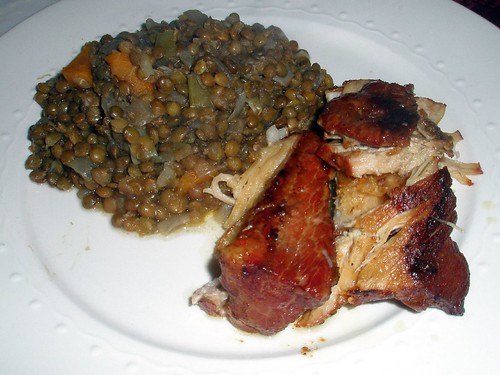
I thought that the best way to show my appreciation for Tom Colicchio after he kindly answered my questions was to cook one of his signature recipes. His recipe for braised fresh "bacon" in Think Like a Chef helped bring the pork belly craze into home kitchens. As simple as the dish is to prepare, it is certainly restaurant-quality. I served it with Chef Colicchio's lentils, celebrating the beginning of autumn in New York.


Braised Pork Belly
Serves 4

Ingredients:
  • 1 Tbsp olive oil
  • Salt and pepper, to taste
  • 2 lbs. pork belly, preferably with skin on
  • 1 onion, chopped
  • 2 carrots, peeled and chopped
  • 2 celery stalks, chopped
  • 1 leek, white part only, chopped
  • 2 garlic cloves, peeled and smashed
  • 3 cups chicken stock

Directions:
  1. Heat of to 350F.
  2. Pat dry the pork belly with a paper towel and season with salt and pepper.
  3. Heat oil in a large skillet over medium heat. Add pork, skin side down, and cook until well browned, about 15 minutes. Set pork aside.
  4. Pour off all but 2 tbsp fat and add onion, carrots, celery, leek, and garlic. Stir to coat the vegetables with oil. Cook, stirring occasionally, until the vegetables are soft, about 20 minutes.
  5. Add pork belly to the pan along with 2 cups of chicken stock. Bring to a simmer, then transfer the skillet to the oven. Cook, uncovered, for 1 hour.
  6. Add the rest of the stock and cook until pork is tender, approximately 1 hour.
  7. Remove the skillet from the oven and let the pork cool. Once cooled, remove the skin with your fingers and discard or eat it. Score the fat, then cut the pork into 4 pieces.
  8. Increase the oven heat to 400F.
  9. Strain the braising liquid, discarding the solids, and return the liquid to the skillet. Bring the liquid to a simmer and skim off any fat.
  10. Return the pork, fat-side up, to the skillet. Transfer the skillet to the oven and cook until the fat is browned, about 20 minutes. Serve immediately.

LinkWithin

Related Posts with Thumbnails