Showing posts with label poultry. Show all posts

Tuesday, April 13, 2010

Braised Turkey Thighs with Cider, Bacon and Potatoes


When I shop for food, I like to create challenges for myself by purchasing meats and vegetables that I have never cooked before.  That is exactly how I ended up with four monstrous turkey thighs in my shopping basket this past weekend.  While buying the least expensive protein out there did not take too much thought, I had little idea of how to prepare them.  Browsing my cookbook collection, I settled on braising the thighs,  which I hoped would ensure that they stayed moist; after all, there is nothing worse than dried-out turkey.  This typical Thanksgiving bird seems to do well with a sweet component--think cranberry sauce-- so I decided to add some hard apple cider to the braising liquid.  As for the bacon and potatoes, well those two ingredients just make everything taste better.


Braised Turkey Thighs with Cider, Bacon and Potatoes
Serves 4 to 6


Ingredients:
  • 4 slices of thick-cut bacon, cut into 1/2-inch pieces
  • 4 turkey thighs
  • salt and pepper
  • 1 carrot, finely chopped
  • 1 celery stalk, finely chopped
  • 1 yellow onion, finely chopped
  • 3 thyme sprigs
  • 1/2 cup hard apple cider
  • 1 cup chicken broth
  • 1 lb. small Yukon gold potatoes, peeled and chopped into quarters
Directions:
  1. Preheat the oven to 300F.
  2. Wash and thoroughly dry the turkey thighs.  Season them on all sides with salt and pepper and set the thighs aside. 
  3. Add the bacon to a large Dutch oven and heat over medium heat.  Cook the bacon, stirring occasionally, until it begins to crisp, 3 to 5 minutes.  Remove the bacon with a slotted spoon and set it aside.  
  4. Increase the heat to medium-high.  Add the turkey thighs to the Dutch oven skin-side down. Do not crowd the turkey thighs; if necessary cook them in two batches.  Cook the turkey until it is well-browned on both sides, about 5 minutes per side.  Remove the turkey legs to a plate and discard all but 1 tbsp of oil from the Dutch oven.
  5. Add the carrot, celery, and onion to the dutch oven.  Cook the vegetables, stirring occasionally, until they begin to brown, about 5 minutes.
  6. Add the thyme and cider to the pan.  Bring the cider to a boil and stir well to break up any brown bits at the bottom of the pan.  Boil the cider until it is reduced by half, about 2 minutes.
  7. Stir in the chicken stock.  Bring the stock to a boil, then reduce the heat to a slow simmer.  Add the potatoes.  Sprinkle the reserved bacon over the potatoes.  
  8. Add the turkey thighs to the Dutch oven, skin-side down.  Cover the pan and place it in the oven.  Cook for 30 minutes, then flip the turkey thighs.  Replace the cover and continue cooking until the turkey is tender, another 30 to 40 minutes. 
  9. Place each turkey thigh in a bowl along with some potatoes.  Spoon off as much fat from the top of the liquid as you can.  Taste the braising liquid for salt and pepper and pour some of it over each serving of turkey and potatoes. 

Sunday, April 4, 2010

How to Cook a Duck Breast

For many home cooks, duck is one of the more intimidating proteins to cook, a meat that most believe is best relegated to restaurant kitchens.  In reality, a duck breast is just as easy to cook as a chicken breast.  But if you follow the instructions I have laid out for cooking duck breast below, you can ensure that you will consistently have perfectly cooked duck, with crispy skin on the outside and medium-rare meat on the inside.

The first order of business when cooking a duck is to trim away any skin that overlapping the meat.  Next, you want to score the skin in a crosshatch pattern as I have done below.  Leave about a 1/4 inch between slices of the knife, and be very careful not to cut into the meat.  The crosshatch pattern will ensure that the skin crisps up as the duck cooks.  Once you have scored the skin, pat the duck dry with paper towels. 

Now, for the seasoning.  If you are going to make a sauce to serve with the duck, the duck needs little more than salt and pepper on both sides.  However, I prefer to serve duck sauceless, letting the rich  flavors of the duck meat stand out on their own.  Using a recipe from Thomas Keller's Ad Hoc at Home, I simply marinated my duck breast in a seasoning of orange zest, nutmeg, thyme, bay leaves, salt and pepper, and a splash of balsamic vinegar.


Once you are ready to cook the duck breast, preheat the oven to 400F.  Depending on how many duck breasts you are cooking, use a large skillet or two large skillets that will comfortably hold the duck breasts with plenty of room to move them around as they cook.  Add just enough canola oil to coat each skillet and heat the oil over medium-low heat.  Add the breasts to the pan, skin-side down.  Let them cook until the skin is nicely browned and crispy, about 17 to 20 minutes.  Periodically check on the doneness of the skin and move the duck breasts to different parts of the pan to ensure that they evenly cook.  Also, occasionally pour out the fat that collects in the pan so that there is always no more than 1/4-inch of fat in the skillet.  Duck fat is delicious to cook with, so save it for a later use.

Once the skin is cooked, flip the breasts and sear the meat side for a minute.  Flip the duck breasts once again so that they are skin-side down in the pan. Finally, pop each skillet into the 400F oven and cook the duck breasts until they are medium-rare, about 5 minutes.  Remove the duck breasts from the oven and place them on a plate.  Tent the plate with foil and let the duck breasts rest for 5 to 10 minutes to allow them to reabsorb the meat juices.  Slice each duck breast against the grain into thin slices and serve them immediately. 

Wednesday, December 30, 2009

Game Hens in an Indian Apricot Sauce


This recipe, adapted from Julie Sahni's Classic Indian Cooking, proves that fruit-based savory sauces don't always have to be cloyingly sweet.  The apricots make the dish pleasantly tart and the garam masala and ginger give some spice.  Serve it with plenty of Basmati rice. 

Game Hens Braised in Fragrant Apricot Sauce
Adapted from Classic Indian Cooking

Ingredients:
  • 2 game hens, skinned and cut in half through the breast bone
  • 1 cup dried apricots
  • 5 tbsp clarified butter or vegetable oil
  • 1 yellow onion, finely diced
  • 1 tbsp ginger, minced
  • 2 tsp garam masala (store-bought or homemade)
  • 3/4 cup canned chopped tomatoes
  • 1 1/4 tsp salt
Directions:
  1. Place the apricots in a small bowl.  Pour boiling water over the apricots, covering them by 1-inch.  Let the apricots soak for two hours.  
  2. Drain the apricots and finely chop them.  Set them aside.
  3. Preheat the oven to 375F. 
  4. Heat a large skillet over medium-high heat.  Add 2 tbsp of clarified butter and cook the game hens until well-browned on each side, 6 to 8 minutes total.  If necessary so as not to crowd the pan, brown the game hens in two batches.  Once cooked, place the game hens in a casserole dish large enough to hold them in one layer.  
  5. Add the remaining clarified butter to the skillet.  Add the onion and cook until it turns light brown, stirring constantly to prevent burning.
  6. Add the ginger to the skillet and cook until fragrant.
  7. Stir in the garam masala to the skillet and cook for a few seconds.
  8. Add the rest of the ingredients to the skillet, plus 3/4 cup water.  Bring the mixture to a boil, then reduce to a simmer.  Cook until the sauce reduces to a thick puree, approximately 10 minutes.  Remove the skillet from the heat. 
  9. Pour the apricot mixture over the game hens.  Pour 1/4 cup of water down the sides of the casserole dish and cover it with foil.
  10. Place the casserole dish in the 375F oven and cook for 25 minutes.  
  11. Reduce the oven to 325F and cook for another 25 minutes.  Serve immediately or refrigerate for up to two days.

Monday, December 21, 2009

Thomas Keller's Ad Hoc Fried Chicken

I may not have found much time to blog the last few weeks, but that didn’t stop me from caving into a recent fried chicken craving. It must have been all of the praise on the blogosphere for Thomas Keller’s buttermilk fried chicken recipe from his latest cookbook, Ad Hoc at Home, for I just could not resist making a mess of my kitchen and giving Chef Keller’s recipe a spin of my own. The mess I created and the calories I ingested were well worth it, as the fried chicken was easily the best fried chicken I have ever had. The recipe can be found all over the Internet at this point (here’s one place to find it), so I won’t type it up again, but it is worth expanding on exactly what makes Thomas Keller’s fried chicken so perfect. What I love about his recipes, as complicated and precise as they may be, is that every ingredient and every step serve a clear purpose. There are three keys to his fried chicken recipe that make it the crispiest and most succulent fried chicken I have ever tasted:
  • The Brine: Have you ever wondered why restaurant chicken and pork is so much more juicy and so much more flavorful than what you cook at home, even when you purchase the best locally-produced, pasture-raised, all-organic, massaged-by-Cretan-virgins meat you can find? It’s not because the cooks have some magic up their sleeves. Often, it’s the restaurant is using a simple flavoring technique that you can just as easily use at home: brining. By soaking the meat in a brine for 12 hours prior to cooking it, the muscle cells will absorb the liquid of the brine via osmosis. In non-scientific words, a brine makes for supremely juicy meat. Keller does one better by adding lemon halves, thyme, parsley, garlic, and honey to the brine; the chicken soaks up all of those flavors making Keller’s fried chicken reach that pinnacle of fried birds where the meat is as delicious as the crust.
  • The Crust: To ensure an exceptionally crispy and flavorful crust, Keller instructs us to dredge the chicken in two layers of seasoned flour (with buttermilk between the two layers). The key to this technique is to make sure that you shake off the excess coating so that the crust on the chicken is crispy but not too thick. Keller spikes his flour with paprika, cayenne, garlic powder, and onion powder, which all lend the crust a nice bite.
  • The Buttermilk Coating: Like many fried chicken recipes, Keller’s calls for coating the chicken pieces in buttermilk. Although the chicken has already been brined, the buttermilk coating acts almost as a second brine, sealing in all of the chicken’s juices to ensure that very little moisture escapes as it is cooked.

What I love about Thomas Keller’s recipes, as complicated and precise as they may be, is that every ingredient and every step serve a clear purpose. The Ad Hoc at Home recipe may take more time and effort to make than your average fried chicken, but in carrying it out, you will perfect the three pillars that produce the ultimate fried chicken.

Sunday, November 8, 2009

Braised Chicken Thighs with Mushrooms and Bacon


By now, it should be no secret that braising is my favorite cooking method. Aside from the obvious attractiveness of braising (makes delicious leftovers, uses inexpensive cuts of meat, etc.), I love braising because I am comfortable and confident enough with it that I do not need to use a recipe to come up with a flavorful dish. As long as you follow the basic formula of browning the meat, sauteing the aromatics, deglazing the pan, adding the braising liquid, and cooking until the meat is tender, you are virtually guaranteed a nice meal.

All I did with for the below recipe was to follow the aforementioned technique using the ingredients that I had on hand. Braising really is that easy. These braised chicken thighs have a wonderfully rich and earthy sauce thanks to the mushrooms and bacon. Serve them over polenta to soak up the liquid.

Braised Chicken Thighs with Mushrooms and Bacon
Serves 4

Ingredients:
  • 8 bone-in chicken thighs
  • Salt and pepper
  • 3 slices bacon, chopped
  • 1 medium yellow onion, finely chopped
  • 10 oz. button mushrooms, thinly sliced
  • 3 garlic cloves, minced
  • 1/2 cup dry white wine or vermouth
  • 1/2 cup chicken stock
  • 1/4 cup chopped parsley
Directions:
  1. Season the chicken thighs with salt and pepper. Set aside.
  2. In a deep skillet over medium heat, saute the bacon until beginning to brown, about 5 minutes. Remove the bacon with a slotted spoon and drain on a paper towel-lined plate.
  3. Add the chicken thighs to the skillet, careful not to crowd them. If necessary, cook in two batches. Cook the chicken thighs until well browned, 3 to 5 minutes per side. Set chicken aside on a plate.
  4. Pour off all but 2 tablespoons of fat from the pan. Add onions, garlic, and mushrooms to skillet. Cook, stirring occasionally, until the mushrooms begin to brown and have released their moisture, about 10 minutes.
  5. Pour the wine into the skillet and bring to a boil. Stirring up any brown bits that have stuck to the bottom of a pan with a wooden spoon, reduce the wine by half, about 4 minutes.
  6. Add the stock to the pan and bring to a boil. Reduce to a simmer and add the chicken thighs. Cover and cook until the chicken is cooked through, approximately twenty minutes, turning once. Remove the chicken to a warmed plate.
  7. If the sauce needs to be thickened, bring it to a boil and cook until it reaches a desired consistency. Stir in the parsley and season it with salt and pepper. Serve the chicken thighs with the braising liquid.

Tuesday, April 7, 2009

Chicken Cacciatore


I do love my no-fuss recipes, especially on work nights. As the story goes, hunters would make cacciatore ("hunter-style") chicken with the ingredients they carried along on their hunts. The story may be far-fetched, but this really is an easy dish to cook. Serve it over plenty of polenta to soak of the braising liquid.

Chicken Cacciatore
Serves 4

Ingredients:
  • 3 lbs. chicken drumsticks and thighs, washed and thoroughly dried
  • Salt and pepper
  • 2 Tb olive oil
  • 1 medium yellow onion, thinly sliced
  • 4 cloves garlic, minced
  • 3 carrots, peeled and sliced into 1/4 inch pieces
  • Large handful of shiitake mushrooms, sliced
  • 1 tsp. juniper berries, crushed
  • 1 cup dry white wine
  • 1 cup canned tomatoes with juice, chopped

Directions:
  1. Heat olive oil over med-high heat in a deep skillet.
  2. Season chicken with salt and pepper. Add to skillet, skin side down. Do not crowd; if necessary brown chicken in two batches. Cook chicken until well browned, about 5 min. per side. Remove to plate.
  3. Discard all but 1 Tb of fat in skillet. Reduce heat to medium and add onion, garlic, carrots, mushrooms, and juniper berries. Cook, stirring occasionally, until vegetables soften, about 8 minutes.
  4. Add wine to skillet and let come to a boil, increasing heat if necessary. Boil for a minute.
  5. Add tomatoes to pan, and stir to mix liquids. Add chicken to pan reduce heat to low; bring to a simmer and partially cover skillet. Simmer until chicken is cooked through, about 25 minutes, turning chicken mid way through cooking.


Thursday, March 5, 2009

Roasted Chicken with Salsa Verde from A16: Food + Wine

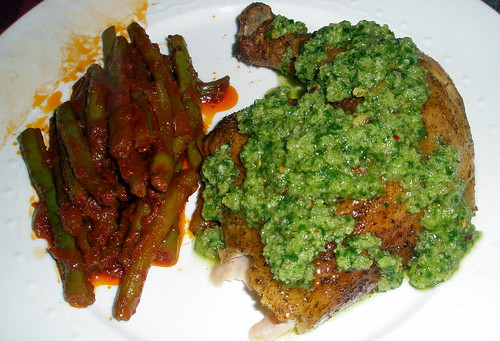
To me, a new cookbook is like a new toy to child; shortly after buying one, I just can't stop playing with it. In the case of A16: Food + Wine, I have a new toy that I don't think I will ever grow bored of. I've already sung my praises for this cookbook, but I would like to report on yet another excellent dish that I cooked from it: Roasted Chicken with Salsa Verde.

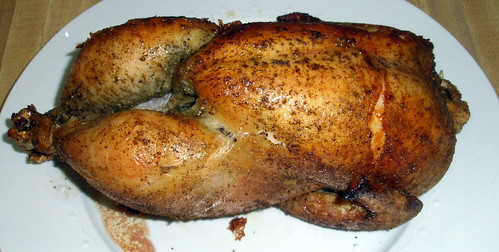
The recipe is actually for tiny roasted young chickens, but I had picked up a nice 3lb. Giannone chicken, so used that instead. I also ran out of dried oregano so I substituted dried sage for some of the oregano that the recipe called for. The chicken still turned out beautifully: a wonderfully crispy skin, juicy and flavorful meat. The salsa verde is excellent as well; my girlfriend who abhors parsely gave it her approval, so don't be alarmed by the cup of parsley that goes into the sauce.

There are two keys to this dish. First, spend a little extra to get a quality bird; chicken quality makes an especially big difference when it comes to simply roasted chicken. Second, the chicken benefits greatly from the two day seasoning process. Planning a recipe two days in advance can be a hassle, but after two days, the seasoning permeates the meat nicely. As an added bonus, this process allows you to just toss the chicken in the oven when you are ready to cook it rather than taking the time to wash, dry, and season the chicken first.


Roasted Chicken with Salsa Verde


For the Chicken:
  • 1 good-quality 3lb. chicken, washed and thoroughly dried
  • 3 Tb kosher salt (yes, 3; don't be shy)
  • 1 1/2 Tb dried oregano
  • 1 1/2 Tb dried sage
  • 1/2 ts dried chile flakes

For the Salsa Verde:
  • 1cup flat leaf parsley
  • 1/2 ts dried chile flakes
  • 1/2 ts capers, drained
  • 1/2 cup fresh breadcrumbs
  • 1/2 cup extra virgin olive oil
  • 1/2 of a lemon
  • small clove of garlic (or 1/2 of a large clove)
  • pinch of salt

Directions:
  1. Two days prior to cooking, grind oregano, sage, and chile flakes in a spice grinder. Rub chicken skin and cavity with salt. Then, rub spice mixture on skin and in cavity. Cover and refrigerate for two days.
  2. Cook chicken at 450F until cooked through, about 50 minutes. Meanwhile, make the salsa verde.
  3. For salsa verde, add parsley, breadcrumbs, chile flakes, capers, and garlic to food processor. Pulse until well blended. While running processor, drizzle in olive oil. Add lemon juice and pinch of salt and process to blend.
  4. Once chicken is cooked, let it rest for 10 min. Serve with salsa verde.


Wednesday, June 25, 2008

Roast Chicken

Roast Chicken

June 25, 2008 · 1 Comment

For tonight’s dinner, I had roast chicken with leftover curried Christmas limas and sauteed kale. I’ll ignore the boring side dishes, and just focus on the chicken.

While there are countless techniques for roasting a chicken, the one thing to remember about roast chicken is that butter and salt are your best friends. A great roast chicken shouldn’t be diet food. I’ve found that more salt = crispier skin and more butter = moist meat. The other seasonings can vary, but don’t skimp on butter or salt.

I used a tiny 2 lb. chicken from Knoll Crest Farm that I bought at the Greenmarket this past weekend. Immediately when I came home from work, I pulled the chicken out of the fridge, washed it, and dried it thoroughly with paper towels. I then set the chicken aside on a platter and preheated the oven to 375 degrees.

Next, I went through my fridge and pantry to see how I would season the chicken. I pulled up some thyme and some garlic. A lemon would have been great, but alas, I did not have any lemon, so I made due with the thyme and garlic. I chopped up about a quarter cup of thyme leaves, minced two cloves of garlic, and threw the two into a bowel. I also set aside a few sprigs of thyme and two crushed garlic cloves.

I then pulled out the butter. I sliced off a healthy 1/4 stick and threw it into the bowl with the garlic and thyme. I then added a large dashes of salt and pepper to the bowl. I mixed the garlic, butter, thyme and s&p with my hands to make a thick paste. I rubbed the paste all over the chicken, sticking a few sizable chunks under the skin of the breast. Finally, I poured a waterfall of salt (yes, more salt) over the chicken. If you think you’ve poured on a lot of salt, keep pouring another second. Here’s how it all looked before I stuck it in the oven:

I assumed my small chicken would take no more than 45 minutes to cook in the 375 degree oven. However, after 45 minutes, the temperature on my thermometer read 150 degrees and the skin was not very brown. I pumped the oven up to 450 and stuck the chicken in for another 7 minutes or so, when the thermometer read 160 and the skin had browned slightly. I set the chicken on a platter for ten minutes. Meanwhile, I added a splash of white vinegar to the pan I had roasted the chicken in and stirred up all the browned bits at the pan. This step not only cleaned my skillet nicely, but it also made a nice pan sauce for my chicken. I poured the sauce over the resting chicken. The result was a tasty, non-diet roast chicken.

Monday, June 23, 2008

Duck with Madeira Cherry Sauce, Mashed Potatoes with Kale, and Roasted Asparagus

Duck is one of my favorite meats. However, I’ve never been able to perfect duck breast at home. The skin is never crispy enough. and the meat usually ends up being overcooked. I’ve tried searing the skin on the stove, then throwing the breast in the oven, as well as cooking the breast on the stovetop the entire time, but I always get the same disappointing results. Due to my duck inadequacies at home, duck is something I often order at restaurants, wondering why restaurant-cooked duck tends to be cooked so perfectly: nicely crisp skin and perfectly medium rare meat.

Tonight, I decided to try my luck at duck once again. I bought the some sweet cherries (first of the summer!) at the Greenmarket yesterday, so I decided to go with this recipe for duck with a Port cherry sauce, substituting Madeira for the Port because that was what I had on hand. I served it with olive oil mashed potatoes with kale, ramps, and garlic scapes, inspired by this recipe from 101 Cookbooks. I also used up the rest of the now dinky-looking asparagus from last week by roasting them in the oven with olive oil, salt and pepper at 350 degrees for 15 minutes.

As for the verdict on the duck? I think I finally got it right, but decide for yourself.

Duck, resting after sauteeing over medium heat, 10 min. skin down, 5 min. skin up:

Duck, plated:

LinkWithin

Related Posts with Thumbnails