Showing posts with label pasta. Show all posts

Sunday, April 10, 2011

Ricotta Gnocchi


I made gnocchi once before, and while they weren't bad for a first attempt, they were not the light and fluffy pillows of pasta that I crave when I think about gnocchi.  Nearly two years later (time sure does fly, doesn't it!), I have made another attempt at gnocchi, and I think I finally figured it out this time around.  The key is to have extremely delicate touch when handling the dough.  As someone who has never been known for having a light touch—watch me do ten layups on a basketball hoop you'll see what I mean—I found this to be easier said than done. But just remind yourself every step of the way to have gentle hands, combining the ingredients of the dough just enough and rolling the dough as delicately as possible, and you will be well on your way to perfect gnocchi.  If my clumsy hands can do it, great gnocchi is certainly within anyone's reach.

Ricotta Gnocchi
Adapted from A16: Food + Wine
Serves 4

Ingredients:
  • 2 cups fresh sheep milk ricotta cheese
  • 2 tbsp olive oil
  • 3/4 tsp salt
  • 1 egg yolk
  • 1 egg, lightly beaten
  • 1 cup "00" pasta flour or all-purpose flour, plus more as needed
  • 1/2 cup semolina flour
Directions: 
  1. In a large bowl, combine the ricotta, olive oil, and 3/4 tsp salt.  Taste the mixture for seasoning and add more salt if necessary.  It should be fairly salty since the flour will even out the salt level.  
  2. Stir the ricotta mixture until it is smooth in appearance, with no large curds visible.
  3. Stir in the egg yolk and half of the beaten egg and stir until just combined.
  4. Find a large, clean work surface and coat it with 1/2 a cup of the "00" pasta flour.  Spread the ricotta mixture on top of the flour, and top it with the remaining 1/2 cup of "00" pasta flour.
  5. Using your hands, gently fold the flour onto the ricotta mixture.  Continue to do so just until the dough comes together.  The dough should be slightly sticky, but should not stick to your fingers.  If it is too sticky, fold in a bit more flour.  
  6. Lightly dust a large cutting board or other large work surface with semolina flour.  
  7. Divide the gnocchi dough into 6 pieces.
  8. Take one piece of the gnocchi dough and, using a very gentle touch, roll it in the semolina flour until it forms a long long about a 1/2 inch in diameter.  Repeat with the remaining pieces of dough.
  9. Using a sharp knife or pizza cutter, cut each log of dough into 1-inch pieces.  At this point, the gnocchi can be cooked or frozen for a later use.
  10. To cook the gnocchi, bring a large pot of salted water to a boil.  Add the gnocchi and wait for the pasta to float in the water, about two minutes; let the gnocchi cook for an additional minute after they float.  Using a mesh strainer, remove the gnocchi from pot.  Serve immediately with the sauce of your choice.  Pesto or a simple tomato sauce work particularly well.

Sunday, February 13, 2011

Cavatelli with Sausage & Browned Sage Butter


 As you may have noticed from the lack of posts on this blog the last few weeks, I have been very busy of late.  When I don't have time to cook, I usually fall into a boring routine of eating leftovers and takeout meals, but I do keep a few super simple recipes up my sleeve that take so little time and make such use of pantry and freezer staples that I have little excuse not to cook when pressed for time.  This pasta dish falls right into that category: store-bought fresh cavatelli (okay, maybe that's not such a pantry staple) tossed in a sausage and sage butter sauce.  The recipe, adapted from The Frankies Spuntino Kitchen Companion & Cooking Manual, which has quickly become a favorite of mine for simple recipes like this one, takes less than 30 minutes to prepare and you'd never know it because it's so full of flavor. 

Cavatelli Sausage & Browned Sage Butter
Adapted from The Frankies Spuntino Kitchen Companion & Cooking Manual

Serves 4

Ingredients:
  • 1 lb. hot Italian sausage links
  • 7 tablespoons butter
  • 10 sage leaves
  • pepper, to taste
  • 1 lb. fresh cavatelli
  • 1 cup grated Pecorino Romano cheese
  • 1/2 cup parsley leaves, finely chopped
Directions:
  1. Bring a large pot of salted water to a boil.
  2. Meanwhile, place the sausages in a large saute pan.  Fill the pan with enough water to come half way up the sausage links.  Heat the pan over medium heat and cook for 10 minutes.  Turn the sausages and cook on the other side for 5 minutes. Remove the sausages from the pan and slice into 1/2 inch slices.  Set the sausage aside.
  3. Melt 1 tablespoon of the butter over medium-high heat in a clean saute pan.  Add the sausage slices and let them cook, undisturbed, until they are well browned on one side, 3 to 4 minutes.  Flip the sausage slices and brown the other side, another 2 to 3 minutes.  Remove the sausage slices with a slotted spoon and place them on a paper towel-lined plate.  
  4. Return the pan to the burner and add the remaining 6 tablespoons of butter, pepper, and sage leaves to the pan.  Stir the butter with a wooden spoon, scraping the bottom of the pan to dislodge any brown bits.  Let cook until it is well browned, about 5 minutes.
  5. Meanwhile, while the butter sauce is browning, place the cavatelli into the boiling water and cook until al dente.
  6. Drain the pasta and add it to the butter.  Stir in the sausage and Pecorino Romano cheese and serve immediately, topping each serving with a pinch of the chopped parsley.

Sunday, November 7, 2010

Spaghetti with Anchovies and Caramelized Onions

On my recent shopping trip to Eataly, I picked up a can of salt-packed anchovies. Whole salt-packed anchovies are to oil-packed anchovy fillets what jarred oil-packed Italian tuna is to domestic water-packed canned tuna. Sure, they cost more and take a bit more effort to cook with, but the taste of salt-packed anchovies is levels above their oil-packed brethren.


This simple pasta should appeal even to the anchovy-haters, of which we all know there are many. While the anchovy flavor is apparent, the dish is not fishy.  Combined with the caramelized onions, olive oil, and toasted breadcrumbs, the anchovies make a light sauce that is much more than the sum of its parts.

It does take some time to fillet the anchovies, but the rest of this dish can be put together in under 30 minutes.  Unfortunately, as I had few anchovy-loving friends and did not want to rub my smelly anchovy fingers on my camera, I do not have any photos of filleting the fish, but it's quite easy.  First, rinse the salt off of each anchovy.  Then soak them in water for about 20 minutes, changing the water few times as they soak. Rinse them off and run the blunt side of a paring knife along each side of the fish to scrape off any scales.  Then, pluck off all of the fins.  Use the paring knife to butterfly each fish.  Pull each fish gently at the tale and pull out the backbone in one clean sweep.  Finally, cut each side of the fish into 3 even fillets.  Then you can relax as you throw together the rest of the dish.


Spaghetti with Anchovies and Caramelized Onions
Serves 4

Ingredients:
  • 1 lb. spaghetti
  • 1/4 tbsp olive oil
  • 2 yellow onions, thinly sliced
  • 3 cloves garlic, thinly sliced
  • 1 tbsp crushed red pepper flakes
  • 6 salt-packed anchovies, filleted
  • 1/4 cup parsley
  • 1/2 cup toasted breadcrumbs
Directions:
  1. Bring a large pot of salted water to a boil.   
  2. Heat 3 tbsp olive oil in a large skillet over medium heat.  Add the onions and cook, stirring occasionally, until they are very soft and golden brown in color, about 20 minutes.
  3. Add the remaining olive oil to the skillet and increase the heat to medium-high.  Add the garlic and red pepper flakes to the pan and cook until the garlic becomes very fragrant, about 1 minute.  
  4. Add the anchovies to the skillet.  Cook, stirring constantly, until the anchovies have completely broken down into the sauce, 3 to 5 minutes.  Reduce the heat to low.
  5. Cook the spaghetti in the boiling water until al dente.
  6. Stir the pasta and the parsley into the sauce.
  7. Serve the pasta in bowls, topped with a few spoonfuls of the toasted breadcrumbs.

Monday, August 23, 2010

Pork Cheek Ravioli with Brown Butter Sage Sauce


 The inspiration for this dish began at Dickson's Farmstand Meats, which has become my butcher of choice in New York, not only for its dedication to selling humanely raised meats from local farmers, but also for the more esoteric cuts of meat that it sells.  It was at Dickson's that I spotted a sign for pork cheeks, and, as is the case with most meats that I am utterly clueless about cooking, I could not resist purchasing a pound of them.


The one thing that I did know about pork cheeks was that they are a tough cut best suited to braising.  However, it being mid-August, a heavy braised dish was not exactly tempting.  I thought about making a pork cheek ragu, but that seemed too much within my comfort zone; I needed to do the pork cheeks some justice.  Staying on the pasta path, I decided that a ravioli stuffed with braised pork cheek would be the perfect way to serve pork cheeks in the summer.  The one problem was that I do not own a pasta maker.  However, I remembered hearing that it was possible to make ravioli using wanton wrappers, and that is exactly what I did.


The results could not have been better.  The braised pork cheeks required three hours of braising time before they were meltingly tender.  Surprisingly, the delicate wanton wrappers were a pretty close substitute for freshly made pasta.  To ensure that the pork cheeks kept the lead role in the dish, I topped the pasta with a simple brown butter sage sauce, which I brightened with lemon juice to pare down the richness of the pork.  On my way home from the butcher, I had been worried about how I would manage to ruin the pork cheeks, but I can't imagine having them any better way. 


Pork Cheek Ravioli with Brown Butter Sage Sauce
Serves 4 

For the pork:
  • 1 lb. boneless pork cheeks
  • salt and pepper
  • 2 tbsp olive oil
  • 2 cloves garlic, minced
  • 1 carrot, finely diced
  • 1 medium yellow onion, finely diced
  • 1/2 cup dry red wine
  • 1/2 cup canned diced tomatoes with their juice
  • 1 cup chicken stock
  • 1 bay leaf
  • 1 tsp fresh thyme leaves
  • 1/2 tsp dried red pepper flakes
For the pasta:
  • 20 wanton wrappers
  • 4 tbsp unsalted butter
  • 10 sage leaves
  • juice from 1/2 lemon
  • salt and pepper
  • grated Pecorino Romano cheese, for serving
Directions:

For the pork (can be made one day ahead):
  1. Preheat the oven to 275F.
  2. Pat the pork cheeks dry with paper towls.  Season with salt and pepper.
  3. Heat the olive oil in a medium braising dish over medium-high heat.  Add the pork cheeks without crowding (cook in batches if necessary), and saute until well-browned on both sides, about 2 minutes per side.  Set the pork cheeks aside on a plate.
  4. Reduce the heat to medium and add the garlic, carrot, and onion.  Cook, stirring occasionally, until the vegetables soften and begin to brown, 5 to 10 minutes.
  5. Add the wine and bring it to a boil.  Reduce the wine by half, about 3 minutes.
  6. Pour in the tomatoes, stock, bay leaf, thyme, and pepper flakes.  Bring the liquid to a boil, then reduce the heat to a simmer.  Add the pork cheeks and any juices that have accumulated on the plate.  Season the dish with salt and pepper. 
  7. Cover the braising dish and place it in the oven.  Cook, flipping the pork the until the the pork cheeks can be easily shredded with a fork, approximately 3 hours.
  8. Remove the pork cheeks from the braising dish and set them aside on a plate.  If necessary, reduce the braising liquid so that it has almost a syrup-like consistency.  Season with salt and pepper. 
  9. Shred the pork cheeks with a fork and return to the braising liquid. Gently warm the dish prior to filling the ravioli.
For the pasta:
  1. Bring a large pot of salted water to a boil.  Reduce the heat to a steady simmer (any more than a simmer will break the ravioli).
  2. Lay each of the wanton wrappers on a large flat surface.  Using a brush or your finger, wet the edges of half of the wrappers.  
  3. Place approximately 1 tbsp of the braised pork, with a bit of the braising liquid, on the ravioli with wet edges. 
  4. Place the remaining wanton wrappers over the pork, forming the ravioli.  Press down on the edges of each ravioli with your fingers to ensure that the edges stick together.  
  5. Use a fork to press down on the edges of each ravioli to form ridges.
  6. Place the ravioli in the pot of simmering water one at a time to ensure that they do not stick.  Cook until the ravioli float to the top of the water, approximately two minutes.  Carefully remove each ravioli from the pasta water with a slotted spoon.  Place 5 ravioli on each plate.
  7. As the ravioli cook, make the sauce by heating the butter over medium heat.  Once the butter has melted and begins to brown, remove it from the heat.  Stir in the sage leaves and lemon juice and taste for salt and pepper.  
  8. Pour a few spoonfuls of the brown butter sage sauce over the ravioli.  Top each plate with a small amount of grated Pecorino Romano.  Serve immediately. 

Wednesday, August 18, 2010

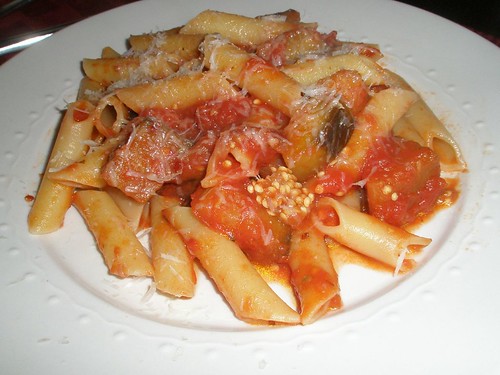
Spaghetti with Spicy Eggplant Marinara


Having recently signed up for the 2010 Philadelphia Marathon, I can look forward to the three months of early morning runs, chafed nipples, and blood blisters on my toes that comes with readying my body for the 26.2 mile race.  The one good that comes from marathon training--aside from looser-fitting clothes--is that it brings on a constant craving for carbohydrates.  With beer and sweets being somewhat off-limits, I turn to pasta to get my carb fix, so be prepared for many pasta recipes the next few months.

To kick off my training, I made a spicy marinara containing slices of fried eggplant and served it over a plateful of spaghetti.  Don't be intimidated by the fried eggplant; eggplant is one of the easiest foods to fry and creates minimal mess.  Just be sure to leave at least 30 minutes to salt the eggplant so that it releases all of its excess water.  Aside from that step, this dish is quick to prepare, and while I'm still looking for a super food to heal my blood blisters, it at least got me through my run the following morning.

Spaghetti with Spicy Eggplant Marinara
Serves 4

Ingredients:
  • 1 large globe eggplant
  • 1 tbsp kosher salt
  • Canola oil, for frying the eggplant
  • 2 tbsp olive oil
  • 3 cloves garlic, minced
  • 1 28 oz. can peeled tomatoes with their juice, crushed by hand 
  • 2 tbsp parsley, chopped
  • 1 tsp hot red pepper flakes
  • 1 lb spaghetti
  • grated Pecorino Romano cheese, for serving
Directions:
  1. Slice off each end of the eggplant.  Slice it into 1/4-inch thick pieces.
  2. Place the eggplant slices in a colander and toss with 1 tbsp salt.  Let the eggplant sit for at least 30 minutes.
  3. Rinse the eggplant and pat it dry with paper towels.
  4. Pour enough canola oil into a saute pan to come 2 inches up the sides.  Heat the oil to 350F.  
  5. Working in batches, add the eggplant to the pan without crowding or overlapping.  Fry until the eggplant begins is golden on one side, 2 to 3 minutes.  Flip the eggplant slices and fry until the other side is golden brown, another 2 to 3 minutes.  Using a slotted spoon, remove the eggplant to a plate lined with paper towels.  Repeat with the remaining eggplant slices.
  6. Heat the olive oil in a large sauce pan over medium heat.
  7. Add the garlic to the pan and stir until it turns golden, about 2 minutes.
  8. Add the tomatoes, parsley and pepper flakes to the pan and bring the mixture to a simmer.  Season it with salt.  Let the sauce simmer until it thickens to a desired consistency and the oil separates, about 30 minutes.  With about 10 minutes left, begin boiling the pasta as per the instructions on the package.
  9. Chop the eggplant slices into quarter-size pieces.  Add them to the sauce and continue to simmer for another 3 minutes.  Taste the sauce for salt and add more red pepper flakes if desired.
  10. Drain the pasta and add it to the sauce.  Serve the pasta immediately,  topped with grated Pecorino Romano cheese. 

Tuesday, May 11, 2010

Thomas Keller's Ad Hoc Meatballs


Meatballs are all the rage in New York these days, appearing on menus all over city.  Hell, there's even The Meatball Shop, a Lower East Side restaurant dedicated to all things meatball.  Naturally, I decided to make meatballs at home this past weekend using Thomas Keller's recipe from  Ad Hoc at Home.  Why leave my apartment for meatballs when I could make my own using a recipe from one of the best chef's in the country? 

It's hard to pinpoint exactly what makes the Ad Hoc meatballs so great.  The mixture is fairly traditional: ground chuck, sirloin, pork, and veal, an egg, breadcrumbs, parsley, sauteed garlic and onions, salt and pepper.  I suspect it's the combination of ground meats that makes the difference, giving each meatball the perfect fat ration. 


 One of the key touches to Keller's meatballs is a small cube of fresh mozzarella cheese that gets inserted into the middle of each meatball prior to cooking them.


In my limited meatball experiences, I have only braised them in tomato sauce.  Keller's are roasted at 425F.  I was concerned that roasting at a high temperature would dry out the meatballs, but the combination of meats and cheese keeps these quite moist.  As anal as Keller supposedly is in the kitchen, I'm sure he would discard any meatball that springs a mozzarella leak, but I think it just makes it more enticing.  Significant Eater actually insisted on being served this one. 


I topped Keller's meatballs with Marcella Hazan's classic tomato-butter sauce, making it a old school meets new school meal. 

Wednesday, April 28, 2010

Springtime "Carbonara" with Ramps and Asparagus


Spaghetti carbonara is one of those classic pasta recipes that you just don’t mess with. Pasta, eggs, Parmesan cheese, guanciale (or pancetta), salt and pepper: those are the only ingredients that should ever go into a carbonara. Don’t add parsley, don’t add peas, and please, please, please don’t add cream. So accept my sincere apologies for calling this dish a carbonara. I really wanted to avoid doing so; it contains heavy cream and smoked bacon—not to mention asparagus and ramps—but that’s what Andrew Carmellini calls it in Urban Italian, from which this recipe is liberally adapted (I substituted bacon for the speck that Carmellini calls for and asparagus for his sugar snap peas and English peas). I’m going to let Mr. Carmellini get away with calling it a carbonara because it is an excellent recipe; with a creamy sauce that clings to each strand of pasta and crispy pieces of cured beat, it has many of the characteristics that I love about carbonara, while the spring vegetables give the dish a more seasonal touch. Regardless of what you want to call it, it will please any carbonara lover out there.

Springtime “Carbonara” with Asparagus and Ramps
Serves 2

Ingredients:
  • ½ cup heavy cream
  • 1 egg
  • 1 handful of asparagus, cleaned, trimmed, and cut into 1-inch pieces
  • ½ lb. spaghetti
  • 4 slices thick-cut bacon, chopped into ½-inch pieces
  • 1 bunch of ramps, cleaned, roots removed, and cut into thirds
  • ½ cup grated Pecorino Romano cheese, plus more for serving
  • black pepper, freshly ground
  • salt, to taste
Directions:
  1. Beat the cream and the egg together in a small bowl until they are well blended. Set aside.
  2. Bring a large pot of salted water to a boil. While waiting for the asparagus to boil, fill a medium bowl with ice water. Add the asparagus to the boiling water and cook until the asparagus turns bright green, 1 to 2 minutes, then use a slotted spoon to immediately plunge the asparagus in the ice water so that it stops cooking.
  3. Add the pasta to the boiling water and cook for one minute less than the package directions indicate. Meanwhile, continue with the rest of the recipe.
  4. Heat a deep-sided skillet or sauté pan over medium-high eat. Add the bacon to the pan and cook, stirring frequently, until the bacon begins to crisp, about 3 minutes.
  5. Add the ramps to the pan and continue to cook until the leaves are wilted and the bulbs begin to brown. Reduce the heat to low, and wait for the pasta to finish cooking, stirring the ramps periodically.
  6. Once the pasta is al dente, drain it, reserving a ½ cup of the cooking water.
  7. Add the asparagus and the reserved pasta water to the skillet. Stir in the pasta, then the cream and egg mixture. There should be just enough liquid in the skillet to coat the pasta, and the sauce should not be watery. If necessary, increase the heat and reduce the sauce to the desired consistency.
  8. Remove the skillet from the heat. Stir in the cheese and a generous amount of ground pepper. Taste for salt. Serve the pasta immediately, with a small amount of Pecorino Romano cheese grated over the top.  

Monday, March 29, 2010

Ziti with Tuna, Red Onions, and Cannellini Beans


I love a recipe that takes old and familiar flavors and transforms them into something completely different.  In his Urban Italian, Andrew Carmellini says that this pasta recipe pays homage to tuna casserole, but I think a more appropriate and more flattering comparison can be made to salad Nicoise.  Between the tang of the lemons and the briny olives and capers, this recipe really is the pasta version of a salad Nicoise.  While the dish is meant to be served warm, I brought the leftover pasta to work and enjoyed it as a cold salad as well.  Now if only there was an easy way to make Cobb salad into a pasta dish...

Ziti with Tuna, Red Onions, and Cannellini Beans
Adapted from Urban Italian

Ingredients:
  • 1 lb penne 
  • 2 tbsp olive oil, plus more for finishing the dish
  • 1 red onion, thinly sliced
  • 1/4 cup dry white wine
  • 1/4 tsp dried red pepper flakes
  • 1 15-oz can cannellini beans, drained and rinsed
  • 1 cup cherry tomatoes, halved
  • 1 1/2 cups good-quality canned tuna in olive oil
  • 1/2 cup pitted Kalamata olives, halved
  • juice and zest of 3 lemons
  • 2 tbsp parsley, chopped
  • 1/4 cup basil, chopped
  • 2 tbsp capers, drained
  • 1 tsp dried oregano
  • salt and pepper, to taste
  • 2 tbsp toasted breadcrumbs
Directions:
  1. Bring salted water to a boil in a large pot.  Cook the pasta in the water according to the package directions.  Drain the pasta and toss with a spoonful of olive oil to prevent the pasta pieces from sticking together.  Set the pasta aside and dry the pot.
  2. Add 2 tbsp olive oil the the pot used to cook the pasta and heat the oil over medium-low heat.  
  3. Add the red onion to the pot and cook, stirring occasionally, until the onion is soft, about 3 minutes.
  4. Pour in the white wine and red pepper flakes.  Bring the wine to a boil and cook, stirring occasionally, until the liquid is almost completely reduced, about 3 minutes.
  5. Reduce the heat to medium-low.  Add the beans and the pasta to the pot and continue to cook for another 2 minutes, stirring frequently.  Remove the pot from the heat. 
  6. Mix in the cherry tomatoes, tuna, olives, lemon juice and zest, parsley, basil, capers, and oregano with the pasta.  Season the pasta with salt and pepper.
  7. Serve the pasta drizzled with olive oil and topped with the toasted breadcrumbs. 

Wednesday, March 24, 2010

Spaghetti all'Amatriciana


After making spaghetti all'Amtriciana with my fresh pancetta the other night, I searched through my blog archive to make sure that I had already posted a recipe for all'Amatriciana sauce, a fiery pasta sauce that has become one of my favorite weeknight meals.  To my dismay, I had never posted the recipe, so here it is. 

My technique for cooking all'Amatriciana is derived from Marcella Hazan's Essentials of Classic Italian Cooking.  Since I used fresh pancetta, which is meatier than the traditional cured pancetta and can be used with slightly less restraint, I cut the pancetta into bigger pieces than I normally would have.  If you use real pancetta, 1/4-inch dice will work best.

Spaghetti all'Amatriciana
Serves 4

Ingredients:
  • 2 tbsp olive oil
  • 1 tbsp butter
  • 1 medium onion, finely chopped
  • 1/4 lb. fresh pancetta, sliced 1/4-inch thick and chopped into 1/2-inch pieces
  • 1 28 oz. can whole peeled San Marzano tomatoes, drained and chopped into small pieces
  • 1 tsp dried red pepper flakes
  • salt, to taste
  • 1 lb. spaghetti or bucatini
  • pecorino romano cheese, for grating over the pasta
Directions:
  1. Heat the oil and butter in a medium saucepan over medium heat.
  2. Add the onion to the pan and sauté it until it is soft and golden, about 3 minutes.
  3. Add the pancetta to the pan and cook for 1-2 minutes.
  4. Stir the tomatoes, red pepper and salt into the saucepan.  Bring the sauce to a gentle simmer and let cook until it is thickened and the flavors are well-combined, about 25 minutes.  Taste the sauce for salt. 
  5. Cook the pasta according to the package directions.  
  6. Drain the pasta and add it to the sauce.  Stir the pasta and sauce for a minute or two until the pasta strands are coated with the sauce.  Serve the pasta immediately, topped with grated pecorino romano cheese.

Wednesday, February 3, 2010

Lamb Ragu


If you need to give yourself something to look forward to this winter, make like an Italian grandmother and whip up a big pot of ragu.  Just don’t tell your Italian grandmother you're making lamb ragu, and a recipe from a fancy-pants New York chef at that.  So maybe it’s not all that authentic, but you have to try Andrew Carmellini’s recipe for lamb ragu from Urban Italian.  All it takes is about 15 minutes of effort, and then you can sit on your couch for a few hours watching Seinfeld re-runs as your kitchen emanates aromas that will warm your entire home.  Try your best to pick up lamb meat from the shoulder—grind your own or ask your butcher to grind it— as the leaner cuts of meat will not be as tender.  It's also worth the effort to scrounge around for canned cherry tomatoes which have a sweet quality that complements lamb nicely.  

Lamb Ragu 
Adapted from Urban Italian

Ingredients:
  • 1/4 cup olive oil
  • 1.5 lbs ground lamb, preferably from the shoulder
  • 1 medium carrot, peeled and diced
  • 1 celery stalk, diced
  • 1 small yellow onion, diced
  • 1 tbsp tomato paste
  • 1.5 cups  dry red wine
  • 1 cup canned cherry or San Marzano tomatoes 
  • 3 cups chicken brother
  • 2 bay leaves
  • 1/2 tsp ground cumin
  • 1/2 tsp ground fennel
  • 1/4 tsp red pepper flakes
  • 1 tbsp thyme leaves
  • 1 tbsp rosemary leaves, chopped
  • salt and pepper, to taste
  • 1 lb fresh pappardelle
  • 2 tbsp butter
  • 1/4 cup freshly grated pecorino cheese
  • 1/4 cup mint, chopped
  • sheep-milk ricotta cheese, for serving 

Directions:
  1. Heat the olive oil in a large pot over medium-high heat.
  2. Add the lamb to the pot.  As the lamb cooks, break it apart with the back of a wooden spoon.  Stir the lamb occasionally until it is browned, about 5 minutes.   If necessary, pour out any excess liquid that accumulates the pot as you cook the lamb; the liquid will steam, rather than brown, the lamb. 
  3. Add the carrot, celery, and onion to the pot.  Cook, stirring occasionally, until the vegetables soften, about 2 minutes.
  4. Add the tomato paste to the pot and stir well for 1 minute.
  5. Pour the red wine into the pot.  Use a wooden spoon to dislodge any browned bits from the bottom of the pot.  Bring the wine to a boil and cook until the wine evaporates completely, about 5 minutes.  
  6. Add the tomatoes, chicken broth, bay leaves, cumin, coriander, fennel, red pepper flakes, thyme, and rosemary to the pot.  Stir well to incorporate the ingredients.  Season with salt and pepper.
  7. Bring the ragu to a boil, then reduce the heat to a gentle simmer.  Cook the sauce until the ingredients are well incorporated and the excess liquid has evaporated, about 2 hours.  Taste the ragu for salt and pepper and keep warm over low heat.
  8. Cook the pappardelle in boiling salted water until it is al dente.  Drain the pasta and add it to the ragu.
  9. Add the butter and mint to the pasta and stir it well until the ragu clings to the noodles.  Serve the pasta immediately, topped with a drizzle of olive oil, the grated pecorino, and a dollop of ricotta cheese.   
 

Sunday, January 31, 2010

Spaghetti with Creamy Tomato and Shrimp Sauce


For this recipe, I tweaked a Marcella Hazan recipe by substituting canned San Marzano tomatoes where she called for tomato paste.  Nonetheless, the recipe results in a creamy pink sauce that is full of shrimp flavor in every bite.  Don't skip the step to make the shrimp paste; cleaning your food processor after pureeing shrimp is not an enjoyable task, but the shrimp paste is essential to making the sauce taste like a shrimp sauce rather than just a creamy tomato sauce that happens to have a few shrimp scattered about.

Spaghetti  with Creamy Tomato and Shrimp Sauce
Serves 4

Ingredients:
  • 1/2 lb medium shrimp, shelled and de-veined
  • 1/3 cup olive oil
  • 2 garlic cloves, thinly sliced
  • 1/4 cup dry white wine
  • 1 28 oz. can whole tomatoes, crushed by hand
  • salt and pepper, to taste
  • 1/2 cup heavy cream
  • 1 lb spaghetti
  • 2 tbsp parsely, finely chopped


Directions:
  1. Cut the shrimp in half lengthwise and set aside.
  2. Heat the olive oil over medium heat.  Add the garlic and cook until it turns light gold.  
  3. Add the wine and tomatoes to the pan and bring to a boil.  Reduce the heat to a gentle simmer.  Cook the tomato sauce, stirring occasionally, until it is thick and all of the ingredients are well-combined. about 30 minutes.  
  4. Add the shrimp, salt, and pepper to the tomato sauce and bring the sauce to a gentle boil.  Cook, stirring frequently, until the shrimp are cooked through, about 2 minutes.  Reduce the heat to medium. 
  5. Using a slotted spoon, remove 2/3 of the shrimp from the pan and puree them in a food processor.  Return the pureed shrimp to the pan and stir the sauce well to combine.  
  6. Add the cream to the sauce and cook, stirring frequently, until the sauce thickens, about 2 minutes.  Taste the sauce for salt and pepper.
  7. Meanwhile, cook the spaghetti according to the package's directions.  Drain the pasta well and add it the tomato sauce.  Stir the pasta well to coat it with sauce.  Serve immediately, garnished with the chopped parsley.

Monday, November 2, 2009

Three-Cheese Lasagna

After returning from a week-long trip, the last thing I feel like doing is cooking dinner. Fortunately, after returning from my recent trip to Florida, all I had to do was heat a square of delicious three-cheese and sausage lasagna that I had made using this recipe from Epicurious. It's everything that a lasagna should be: meaty, cheesy, and saucy (make sure to double the sauce recipe). Best of all, it saved me from takeout.

Monday, September 7, 2009

Rigatoni with Sausage, Chickpeas, Broccoli Rabe and Tomato Sauce


This hearty pasta dish is from Andrew Carmellini's Urban Italian. The ingenious ingredient here is the chickpea puree, which gives the sauce a wonderful creaminess. The method might seem like a lot of dishes to dirty for just one pasta dish, but this pasta is plenty rich to stand on its own without any side dishes. It is well worth the dish cleaning effort it requires.

Rigatoni Pugliese
Serves 4

Ingredients:
  • 1 15 oz. can chickpeas
  • 1/4 cup + 2 tbsp olive oil
  • 1 lb. spicy Italian Sausage
  • 3 cups of your favorite homemade tomato sauce (a simple preparation containing only tomatoes, salt, basil, and oil is all that is necessary. Do not use a store bought sauce.)
  • 1/2 tsp fennel seed, ground
  • 1 bunch broccoli rabe, cleaned and trimmed
  • 1 lb. rigatoni
  • 2 tbsp. olive oil
  • 1 clove garlic, thinly sliced
  • 1/4 tsp. red pepper flakes
  • Salt and pepper, to taste
  • 2 tbsp butter
  • 1 cup pecorino romano cheese, grated

Directions:
  1. Drain the chickpeas, reserving the liquid. Place half of the chickpeas and all of the liquid in the bowl of a food processor and puree.
  2. Heat 1/4 cup olive oil in a large saucepan over medium-high heat.
  3. Remove the sausage from its casing and place in sauce pan. Cook until well browned, using the back of the spoon to break up the meat.
  4. Add the tomato sauce, chickpea puree, and fennel seed to the pan. Simmer until the thickened slightly, about fifteen minutes (the sauce should still have a liquid quality to it).
  5. Bring a large pot of salted water to a boil.
  6. Add the broccoli rabe to the boiling water and blanch for about 90 seconds. Immediately remove with a slotted spoon and place in ice water.
  7. Add the rigatoni to the boiling water and cook until al dente.
  8. Meanwhile, heat two tbsp. olive oil in a skillet over medium-high heat.
  9. Add the broccoli rabe, garlic, red pepper flakes, and remaining chickpeas to the skillet. Season with salt and pepper. Cook for a minute or two. Remove all ingredients with a slotted spoon and add to sausage and tomato mixture.
  10. Once pasta is cooked, drain the water and place the pasta back into the pot. Add the sausage and tomato mixture and stir to coat the pasta.
  11. Add the butter and cheese and stir until butter is melted. Serve immediately.

Tuesday, August 25, 2009

Pasta alla Norma


If only more vegetables were as wonderfully meaty and smoky as eggplant, I might be willing to stick to a vegetarian diet more often. As it is, when eggplants are in season in the summer, I will substitute meat for eggplant at least one night per week. Generally, my vegetarian meal will consist of pasta with eggplant, and there is no greater eggplant pasta dish than pasta alla norma. Upon tasting this rich pasta, you will swear that there must be pancetta or prosciutto in it, but that will just be the eggplant talking.

Pasta alla Norma
Serves 4

Ingredients:
  • 1 eggplant, peeled in alternating strips to make a "zebra" pattern and cubed
  • 1 tbsp Kosher salt plus salt to taste
  • 1/4 cup olive oil
  • 1 28 oz. can San Marzano tomatoes, crushed by hand
  • 1 tsp crushed red pepper flakes
  • Ground pepper, to taste
  • 12 oz. penne pasta
  • 1 handful of basil leaves
  • Grated ricotta salata cheese, for serving
Directions
  1. Place the eggplant in a colander. Toss eggplant with 1 tbsp salt and set aside for 30 minutes.
  2. Rinse eggplant with water and pat dry with paper towels.
  3. Heat oil in a deep skillet over medium heat. Add eggplant cubes and cook until browned on all sides, about three minutes. Remove eggplant with a slotted spoon and set aside.
  4. Add tomatoes, pepper flakes, pepper, and a pinch of salt to skillet and simmer until slightly thickened, about ten minutes.
  5. Meanwhile, cook pasta in salted, boiling water according to package directions.
  6. When the pasta has two minutes longer to cook, add the eggplant and basil to the skillet. Taste for salt and pepper.
  7. Drain pasta and stir it into the skillet.
  8. Serve pasta in bowls topped with grated ricotta salata.

Monday, August 10, 2009

Penne with Eggplant, Olives, Cherry Tomatoes, and Basil


I always get excited when eggplants begin to show up in the New York Greenmarkets in the summer. To me, no vegetable is more delicious with pasta than eggplant. Its meaty and smoky flavor make even this simple meatless pasta dish a very hearty meal.

Penne with Eggplant, Olives, Cherry Tomatoes, and Basil

Serves 4

Ingredients:
  • 12 oz. penne
  • 1 globe eggplant, cubed
  • 1 tbsp kosher salt
  • 1/4 cup + 2 tbsp olive oil
  • 1/2 cup black olives, pitted
  • 1/2 tsp crushed red pepper
  • 1 pint cherry tomatoes, halved
  • 1/2 cup loosely packed basil leaves
Directions:
  1. Place eggplant in a colander and toss with salt. Set aside for half an hour to allow eggplant to release water. Rinse eggplant and pat dry with paper towels.
  2. Heat 2 tbsp olive oil in a large skillet over medium-high heat. Add eggplant and cook, stirring occasionally, until eggplant is browned, about 5 minutes. Remove eggplant and wipe skillet clean.
  3. Add remaining olive oil to skillet and heat over medium-low heat. Add olives, eggplant, and pepper, and simmer.
  4. Meanwhile, cook pasta in salted boiling water according to package directions.
  5. Three minuted before the pasta is cooked, add the cherry tomatoes and basil to the skillet. Continue to simmer, breaking up a few of the tomatoes with the back of a spoon.
  6. When pasta is al dente, drain, reserving 1/2 a cup of the cooking water.
  7. Add pasta to skillet and continue to cook for another minute, until sauce begins to coat the pasta. If necessary, add some pasta cooking liquid to the pan. Serve immediately.

Monday, July 27, 2009

Mac and Cheese Party

One of the things that comes with having a food blog is that co-workers, family members, friends, and significant others (and eaters) all request that you make their favorite foods. If anything, these special requests give me confidence that the meals I cook at least look good on a computer screen.

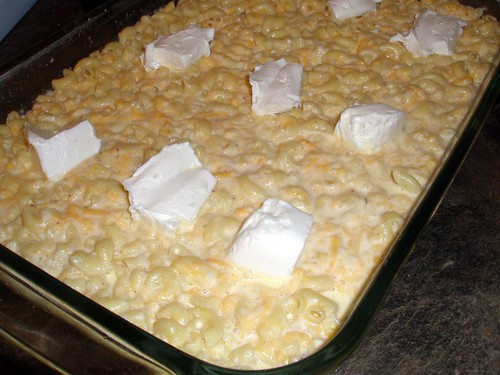
One such cooking request came from the Significant Eater and seven of her girlfriends, when they asked that I cook a macaroni and cheese feast for them. I've never been a fan of mac and cheese, but this was one cooking job I could not turn down. Doing so would have jeopardized my good-boyfriend standing. Despite my dislike for mac and cheese, I would have to make the mac and cheese of my life for the group of mac-and-cheese-loving women.

Scouring for recipes was no easy task for me since I find most mac and cheeses to pretty much the same no matter what goes into them. I felt like a steakhouse chef trying to come up with a salmon dish to put on his menu. I finally came across Jean-Georges Vongeritchen's wife's recipe for mac and cheese. Yes, I decided on a recipe for macaroni and cheese that a French chef proclaims to be the best. How very snobby of me. But with four cheeses and a fairly simple preparation, it sounded like a mac and cheese that would please everyone.

I created another challenge for myself with my mac and cheese party. In my desperate attempt to forever be deemed a good boyfriend by the Significant Eater's friends, I offered to make a healthy version of mac and cheese for those who were averse to eating pasta soaked in milk, cream, half and half, and four cheeses. I myself have an aversion to low fat cheese, so finding a "healthy" version of mac and cheese that I was willing to put my name on proved to be much more difficult than finding a recipe for the standard version. I settled on making carrot mac and cheese. The recipe sounded pretty vile, but I figured if anything, its awfulness would force the health-conscious girls to at least try the four cheese version.

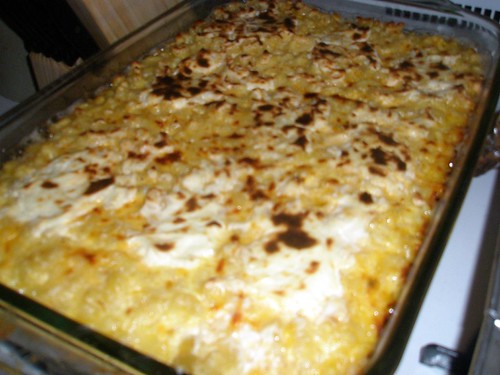
The best thing about any casserole dish is that it is easily transportable. After spending an hour in my own kitchen preparing the two mac and cheeses, they were both packed in their baking dishes and ready to head to the party. While drinking wine and enjoying some hors d'ouevres that one of the girls made, I was able to simply pop the two dishes into the oven. Fifty minutes and a few more glasses of wine later, they were ready to be eaten.

The dinner turned out very well. All of the girls tried and loved the Vongeritchen mac and cheese. Surprisingly, the carrot version, while far from tasting anything like mac and cheese, went over well. Even me, the mac and cheese hater, went back for seconds of each. With yet more wine and some great side dishes that the girls made, it was a very enjoyable dinner. It may have just been the wine speaking, but all of the girls said I did a great job with the mac and cheeses. Will I forever go down in history as great boyfriend material? That, I will not know, but I did woo one of the girls.


Tuesday, July 21, 2009

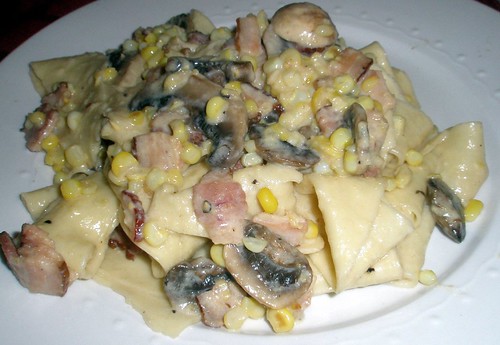
Pappardelle with Corn, Bacon, and Mushrooms


Corn with pasta? Authenticity aside, don't knock it until you've tried it. This recipe was adapted from Andrew Carmellini's Urban Italian. Carmellini states that despite helming the stoves at some of New York City's finest Italian restaurants, he's a Midwesterner at heart. For that reason, he always manages to add corn into his menu when corn season arrives in the summer. If it's good enough for Andrew Carmellini, it's good enough for me; this pasta is excellent, I should add.

Pappardelle with Corn, Bacon, and Mushrooms
Serves 3 to 4

Ingredients:
  • 1 lb. fresh pappardelle pasta
  • 4 ears of sweet corn, kernels removed
  • 3/4 cup of bacon, diced
  • 8 oz. thinly sliced button mushrooms, stems discarded
  • 1/3 cup whole milk
  • 1/3 cup heavy cream
  • pinch of ground cayenne pepper
  • 1/3 cup grated parmesan cheese
  • salt and pepper, to taste
Directions:
  1. Add half of the corn kernels, the milk, and the cream to the bowl of a food processor and process until nearly smooth, approximately 1 minute. Set aside.
  2. Add bacon to a large skillet and cook over medium heat until fat has rendered and some pieces begin to crisp, 3 to 4 minutes.
  3. Add mushrooms and remaining corn kernels to skillet and cook until they begin to brown, 2 to 3 minutes.
  4. Reduce heat to low. Using a mesh strainer to filter out the solids, add the milk and corn mixture to the pan. Press the solids in the strainer with a spoon in order to extract all of the liquid. Simmer mixture for another two minutes or until it has thickened slightly.
  5. Meanwhile, cook the pasta in salted boiling water until al dente.
  6. Add cayenne pepper to skillet. Stir well. Remove pan from heat.
  7. Drain cooked pasta and add it to the skillet.
  8. Add parmesan cheese to skillet and stir well.
  9. Taste for salt and pepper and serve.

Monday, July 13, 2009

Spaghetti with Fava Beans and Pancetta

Pasta with fava beans is a traditional spring-time dish in Southern Italy. Locally grown fava beans may not be available in New York until summer, but it's still perfect dish for warm weather no matter the time of year. The fava beans add a refreshing sweetness, while the pancetta makes this light dish just hearty enough. I adapted the recipe from A16: Food + Wine; follow along to my photographed directions:

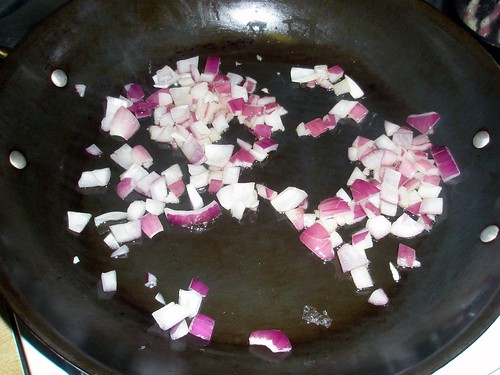
First, set your mise en place (red onion, pancetta, red pepper flakes, blanched and peeled fava beans, spaghetti, pecorino, black pepper, olive oil):


Next, saute the red onion in olive oil over medium heat:


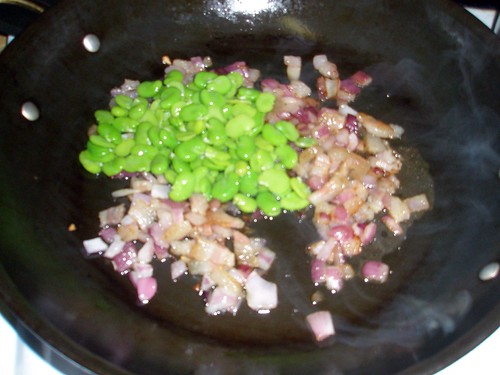
Add the pancetta to the pan and was cook until it begins to get crispy:

Lower the heat to low, toss in the fava beans, pepper, and a ladle of pasta cooking water:


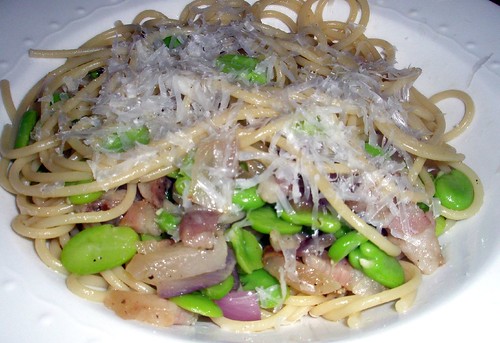
Toss the everything together with the pasta, add some olive oil, and top with grated pecorino cheese and serve:

Tuesday, June 2, 2009

The Joys of Cooking

Normally, I would not write about a recipe I have previously posted on this blog, but sometimes the tried and true is what makes me most appreciative of a home cooked meal. After slaving over complicated recipes, hand washing a countless number of dishes, and spending an inordinate amount of time purchasing food, it can be easy to forget that cooking does not have to be complicated. On the contrary, making a home cooked can be the easiest way to get food to the table, as demonstrated by my recent dinner of rotini with ramps, breadcrumbs, and pecorino cheese. I made this meal after returning home from a recent trip to Florida.

Coming home to a nearly empty refrigerator and being tired from my early morning flight and a long day of work, cooking was the last thing on my mind at the time. However, not wanting to order an unsatisfying delivery meal, I decided that making the always dependable pasta with ramps and breadcrumbs would be the quickest way to get food in my stomach and begin relaxing after my grueling day. So I set a pot of water on the stove, and I began unpacking my suitcase while I let the water come to a boil. By the time I had finished unpacking, the water was boiling, so I added the pasta. With the pasta cooking, I sauteed the breadcrumbs and ramps. Ten minutes later, I was eating my pasta and thinking about how damn wonderful cooking can be.

Sunday, May 31, 2009

Puttanesca Power


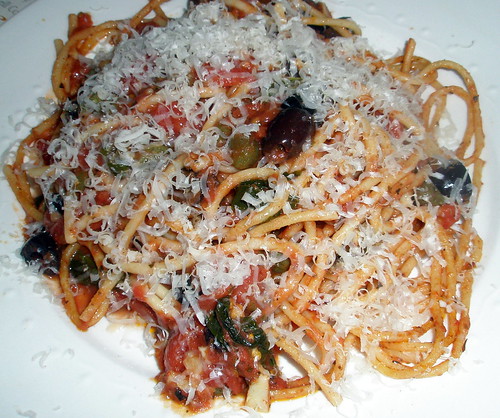
Yesterday, I ran the Brooklyn Half Marathon. With the race day forecast calling for hot and humid conditions and my training being nowhere near adequate, the best pre-race preparation I could do was to eat a carb-heavy meal that would power my ill-trained body through the race. I ended up making spaghetti puttanesca; a meal that was both carb-laden enough to give me energy for all 13.1 miles and salty enough to help me avoid cramps during the race. The result: a personal best half marathon time. Normally, I would take all of the credit for a great race, but this time all the credit goes to the puttanesca power.

Spaghetti Puttanesca
Serves 4

Ingredients:
  • 1 lb. spaghetti
  • kosher salt
  • 1/4 cup olive oil
  • 3 garlic cloves, minced
  • 1 28 oz. can whole tomatoes in juice, crushed by hand
  • 5 basil leaves
  • 3 anchovy fillets, minced
  • 1 1/2 tbsp. capers, drained
  • 1/2 cup pitted Kalamata olives, halved
  • 1/2 tsp. red pepper flakes
  • 1 tsp. oregano
  • Ground black peppercorns
  • Parmesan cheese, grated for serving

Directions:
  1. Cook spaghetti in boiling salted water according to directions on box.
  2. Meanwhile, heat olive oil in a large sauce pan over medium heat. Add garlic and saute until fragrant, about one minute.
  3. Add tomatoes and juice, basil, anchovies, capers, olives, pepper flakes, and oregano. Simmer over medium-low heat until thickened, about 10 minutes. Add pepper to taste.
  4. Drain pasta and toss with sauce. Serve with Parmesan cheese.


LinkWithin

Related Posts with Thumbnails