Showing posts with label seafood. Show all posts

Tuesday, April 12, 2011

Scallops with Fava Beans, Dandelion Greens, Ramps, and Pancetta


 This dish hardly requires a recipe, as it consists of little more than the ingredients listed in the title.  That's what I love about spring produce; it is so delicious on its own that gussying it up with any other ingredients usually does more harm than good.  In this case, I've paired seared jumbo sea scallops with blanched fava beans and dandelion greens, ramps, and crispy pancetta that I have sauteed in a bit of olive oil.  A drizzle of sherry vinegar, a few cracks of salt and pepper, and you have spring on a plate.

Scallops with Fava Beans, Dandelion Greens, Ramps, and Pancetta
Serves 2

Ingredients:
  • 1 lb. fava beans, shelled
  • 2 tbsp
  • 1/4 lb. piece of pancetta, diced
  • 1 bunch of ramps, cleaned, trimmed and cut into 1/4-inch pieces
  • 1 bunch of dandelion greens, cleaned and trimmed
  • 8 large sea scallops
  • salt
  • pepper
  • 1 tbsp butter
  • Sherry vinegar
Directions:
  1. Bring a large pot of salted water to a boil.  Add the shelled fava beans to the water and boil for 2 minutes.  Immediately drain the favas and add them to a bowl of ice water to cool.  Once cooled, peel each fava and place the beans in a bowl.
  2. Heat a tablespoon of olive oil in a large skillet over medium heat.  Add the pancetta and cook, stirring occasionally, until the fat renders and the pancetta begins to crisp.  Add the ramps and cook until some of the pieces begin to brown.  Add the dandelion greens and cook until they begin to wilt.  Season with salt and pepper and drizzle a bit of Sherry vinegar over the greens. 
  3. Meanwhile, as the dandelion pancetta cooks, prepare the scallops.  Pat them dry with a paper towel and season them with salt and pepper.  Heat a tablespoon each of olive oil and butter in a large skillet over high heat.  Add the scallops and cook, undisturbed, until they are well-browned on one side, about 2 to 3 minutes.  Flip the scallops and cook on the other side until it is well-browned, another 2 to 3 minutes.  Set the scallops aside on a plate.
  4. To plate the dish, divide the ramps and dandelion greens among two plates.  Quickly heat the fava beans in one of the skillets just until they are hot and surround the greens with the beans.  Top the greens with the scallops.  Serve immediately.

Tuesday, January 18, 2011

Bay Scallops with Orange Sauce


 I'm not usually a fan of citrus-based sauces, which are all too often much too sweet for my taste. I was apprehensive about making this dish—sweet scallops combined with an orange sauce sounds like a cloyingly sweet combo—but I was surprised at how much I enjoyed it.  Thanks to the smart inclusion of a bit of lemon juice in addition to the orange juice, the sauce has tart undertones, and the addition of herbes de Provence and dried oregano give it just the right savory notes to ensure that it stays well shy of being a melted creamsicle.  I wish I could pat myself on the back for creating the perfect citrus-based sauce, but all credit goes to Andrew Carmellini and his cookbook in which the dish appears, Urban Italian.

Sunday, January 9, 2011

Shrimp Wrapped in Pancetta and Sage


 For my weekday meals, I tend to fall into a monotonous rotation of sauteed chicken breasts and pork chops served with not very imaginative pan sauces.  It's not that I especially love these meals (although I have been known to throw together a darn good pan sauce), it's just that after a long day of work, the last thing I want to do is to struggle with a new recipe, so I stick to the familiar.  I'm always excited when I do go out on a limb and discover a new recipe like this one for shrimp wrapped in pancetta and sage that is simple enough for weeknights.  Thanks to my Manhattan stomping grounds, I do have the luxury of having a market between my office and my apartment that sells both very fresh shrimp and high-quality pancetta, so assuming you can find those two components of the ingredient list, this recipe is as easy as it gets.  It is also quite tasty with the shrimp and crispy pancetta creating somewhat of a high-end hot pocket, perfect for eating on the couch after a harrowing day. 


Shrimp Wrapped in Pancetta and Sage
Serves 2 to 3

Ingredients:
  • 1 lb shrimp, peeled and deveined, tails left on
  • pepper
  • 1 bunch sage
  • 1/4 lb pancetta, thinly sliced
  • 1 tbsp olive oil
Directions:
  1. Lay the shrimp out on a cutting board.
  2. Season the shrimp with pepper.  There is no need to salt the shrimp as the pancetta is very salty.
  3. Place a sage leaf on top of each shrimp.
  4. Wrap a slice of pancetta around each shrimp.
  5. Heat the olive oil in a large skillet until just before smoking.
  6. Gently place the shrimp in the skillet.  Cook without disturbing for 2 minutes then flip each shrimp using a spatula.  Cook the other side until the shrimp are pink and no longer translucent, another 1 to 2 minutes.  Remove the shrimp from the pan and serve immediately. 

Wednesday, September 1, 2010

Swordfish with Creamy Basil and Shrimp Tomato Sauce


I’m still not overly confident when it comes to cooking without a recipe, so I was especially proud of this dish. I asked the Significant Eater what she would like for dinner and she described to me a dish she had eaten on a night out with her girlfriends at Extra Virgin, a quaint Mediterranean restaurant in Manhattan’s East Village. “Monkfish, in a buttery pink tomato sauce, with rock shrimp,” she stated, paraphrasing the surely hunkish waiter who had made the dish so memorable. It sounded easy enough to me, so I went to work. My fishmonger had sold out of monkfish for the day, so I chose the more sustainable swordfish, which I felt would be meaty enough to hold up to the tomato sauce. Similarly, I replaced the rock shrimp with bite-size pieces of larger shrimp. I had a lot of fun simply cooking by taste, sight, and feel: a splash of wine here, a handful of basil there. As the cooking came to a close, I asked the Significant Eater how it looked in comparison to the dish from Extra Virgin. She raised a spoonful of sauce to her lips and exclaimed, “You nailed it!”
Swordfish with Creamy Basil and Shrimp Tomato Sauce
Serves 2, with plenty of extra sauce for pasta the following day

Ingredients:
  • 5 tbsp olive oil
  • 3 tbsp butter
  • 1 28-oz. can whole tomatoes with their juice, crushed by hand
  • salt and pepper
  • ¼ cup dry white wine
  • ¼ cup heavy cream
  • ½ bound medium-size shrimp, peeled and chopped into ½-inch pieces
  • ¼ cup fresh basil, chiffonaded (leaves rolled and thinly sliced)
  • 2 6-oz. swordfish steaks
Directions:
  1. Heat the butter and 3 tbsp of the olive oil in a saucepan over medium heat.
  2. Once the butter has melted, stir in the crushed tomatoes.
  3. Bring the tomatoes to a boil, then reduce the heat to a simmer. Season with salt and pepper and allow the tomatoes to simmer until the sauce is no longer watery, about 30 minutes.
  4. Pour in the wine and return the sauce to a simmer. Allow the sauce to simmer for another 5 minutes.
  5. Stir in the cream, shrimp, and basil and simmer the sauce until it is thick and the shrimp have cooked through, about 5 minutes. While the sauce simmers, prepare the swordfish.
  6. Season the swordfish steaks with salt and pepper.
  7. Heat 2 tbsp olive oil in a skillet over medium-high heat.
  8. Add the swordfish to the pan and cook undisturbed until browned on one side, about 3 minutes. Flip each steak and cook until the other side has browned, 2 to 3 minutes. Set each swordfish steak on a serving plate.
  9. Taste the sauce for salt and pepper.
  10. Spoon the sauce over each swordfish steak and serve immediately.

Wednesday, August 25, 2010

Seared Scallops with Lemon and White Wine


This scallop dish was my triumph over bachelorhood.  I had come home from having a couple beers with my friends and my first thought was order a big bowl of pad see ew from the neighborhood Thai restaurant.  But as my alcohol-induced laziness wore off, I decided that I would cook the jumbo sea scallops that I had purchased earlier in the day.  I scrambled to the stove, seared the scallops in a healthy amount of oil and butter, splashed in some white wine and lemon juice, and served it all over some wilted arugula.  Dinner was ready within 10 minutes, the whole dish cost less than ten bucks, and it tasted a whole lot better than takeout.  Bachelorhood has never felt so glamorous. 

Seared Scallops with Lemon and White Wine
Serves one hungry man

Ingredients:
  • 4 large (U-10 or bigger) sea scallops
  • salt and pepper
  • 2 tbsp olive oil
  • 1 tbsp butter
  • 1 garlic clove, minced
  • 1/4 cup dry white wine
  • juice from 1/4 of a lemon
  • 2 handfuls of arugula or spinach
Directions:
  1. Remove the tough muscle from each scallop and pat them dry with a paper towel.  Season the scallops with salt and pepper.
  2. Heat a cast iron skillet over high heat and pour in 1 tbsp of the oil. 
  3. Once the oil is hot, add the scallops.  Cook undisturbed until they are well browned on the bottom, about 2 1/2 minutes.  
  4. Reduce the heat to medium and flip the scallops.  Add the butter to the pan and continue to cook the scallops, basting frequently with the butter, until they are just cooked through, about 1 1/2 minutes.  Remove the scallops from the pan and set them aside on a plate.
  5. Increase the heat to medium-high.  Add the garlic to the skillet and cook until it is fragrant, about 30 seconds.
  6. Pour the wine into the skillet and bring it to a boil.  Cook until the wine is reduced by half, approximately 2 minutes.  
  7. Meanwhile, as the wine reduces, wash the arugula. Heat 1 tbsp of the oil in a saute pan over medium-high heat.  Add the arugula and a pinch of salt to the pan and cook, stirring frequently, until it begins to wilt, 1 to 2 minutes.  Remove the arugula from the pan and set it aside on a serving plate. 
  8. Remove the skillet with the white wine from the heat and pour in the lemon juice.  Taste the sauce for salt and pepper. 
  9. Top the arugula with the scallops and pour the white wine lemon sauce over the scallops.  Serve immediately. 

Sunday, August 15, 2010

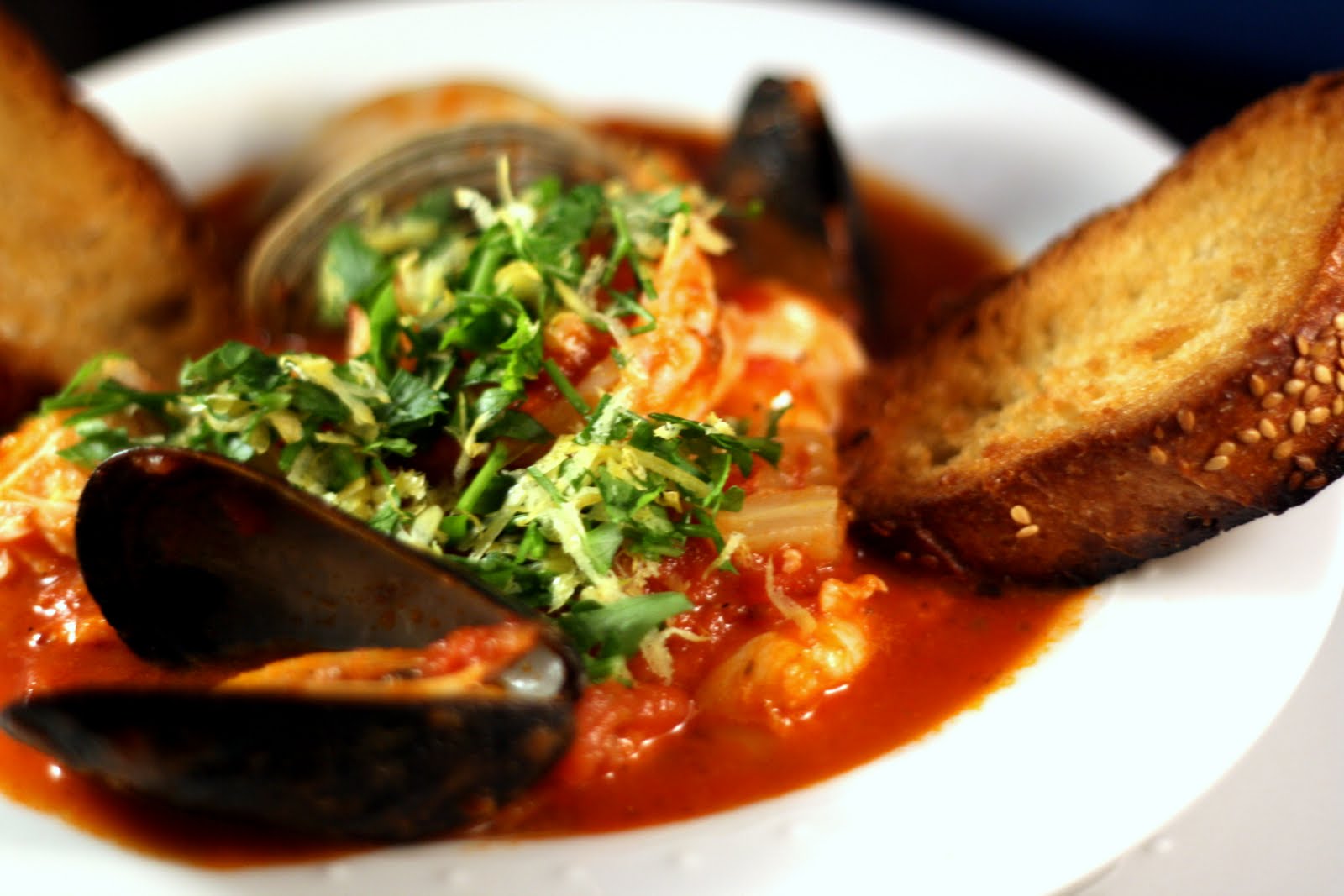
Italian Seafood Stew


 Stew in mid-August? No thank you.  Seafood stew? Well, now that you mention it...

Italian seafood stew, tomato-based and chock full of just about any seafood you want, is one of my favorite dishes that I have made this summer.  I used a recipe from Marco Canora's Salt to Taste, spiking the tomatoes with plenty of lemon and tossing in calamari, little neck clams, mussels, shrimp. and cod.  However, hot summer days are not meant to be spent fretting over recipes, so toss in whatever spices and seafood you like.  Just keep main components the same-- a soffrito of celery, fennel, and onions, a can of crushed tomatoes, a splash of white wine, and some perfectly cooked seafood-- and you are guaranteed a great seafood stew that, when washed down with a crisp white wine, just might take you from a small studio apartment to a beach on the Amalfi Coast.  Unfortunately for this New Yorker, I was quickly awakened from my dream by a truck barreling down Second Avenue, but I plan to revisit it by making this stew at least one more time this summer.   

Sunday, July 25, 2010

A Jambalaya for Gulf Oil Spill Relief


Cajun food isn't something I usually consider cooking.  Don't get me wrong--I absolutely love the cuisine--but I associate Cajun food with huge rambunctious gatherings.  I'm thinking bowls full of gumbo, heaping plates of shrimp etouffee, a pot of steaming crayfish, and bananas foster all washed down with loads of Abita and some Professor Longhair tunes.  Slurping down gumbo in a small studio apartment by myself while watching a ballgame just doesn't come to mind when I think Cajun.  So forgive me for the "Gulf-inspired dinner" I cooked for the Significant Eater and myself.  It may just be a few servings of jambalaya, but thanks to the good folks at Foodbuzz, this dinner is so much more than just a plate of jambalaya; by cooking and blogging about it, $25 is donated to the Greater New Orleans Foundation's Gulf Coast Oil Spill Fund.  What better reason to start cooking Cajun than this?


Jambalaya
Adapted from Food & Wine

Ingredients:
  •  1/4 cup olive oil
  • 12 oz. andouille sausage, slice into 1/4-inch thick pieces
  • 1 celery rib, finely diced
  • 3 cloves garlic, minced
  • 1 yellow onion, finely diced
  • 1 red bell pepper, finely diced
  • 1 1/4 cup white rice
  • 1 tsp. Old Bay seasoning 
  • 1 sprig thyme
  • 1 1/2 cups chicken stock
  • 1 1/2 cups water
  • salt and pepper
  • 4 oz. lump crab meat
  • 8 oz. small shrimp, peeled and deveined
  • 3 scallions, thinly sliced
  • Tabasco, for serving
Directions: 
  1. Heat a large saute pan over high heat.  Add the olive oil and sausage and cook, stirring occasionally, until the sausage is browned on all sides, about 3 minutes.  Remove the sausage with a slotted spoon and reserve.  
  2. Add the bell pepper, celery, garlic, and onion to the olive oil.  Stir the vegetable so that they are coated in oil.  Cover the pan and cook, stirring occasionally, until the vegetables are soft and the onion is translucent, about 3 minutes. 
  3. Add the rice and Old Bay and stir to coat the rice with olive oil.  Cook until the rice is opaque, about 2 minutes.  
  4. Add the stock, water, and thyme to the pan.  Season lightly with salt and pepper and bring the liquid to a boil.  Reduce the heat to very low and cover the pan.  Cook until the rice is tender and the liquid is reduced, about 15 to 25 minutes.  Fluff the rice with a fork.
  5. Stir the shrimp, crab meat, and scallions into the rice and cover the pan.  Continue to cook until the shrimp is cooked through, 3 to 5 minutes.
  6. Taste the jambalaya for salt and pepper.  Serve it in bowls, topped with a few drops of Tabasco. 

Monday, July 19, 2010

Soft-Shell Crabs with Corn and Chorizo


I'm not sure what got into me this weekend, but when searching for a recipe to for some soft-shell crabs I had purchased, Chanterelle was the first cookbook I pulled off my shelf.  Normally, this cookbook from the late Chanterelle, arguably the first restaurant to bring New American cuisine to the Manhattan, is the last cookbook that comes to mind when I am in need of a simple summer recipe.  Even the simplest  recipes in the gorgeous book require require several pans and a few hours of prep time, making them nearly impossible to pull off in a small kitchen.  Up until this weekend, the cookbook had been relegated to use only for inspiration, so I don't know what made me do it, but I am sure glad that I took the book for a spin with this recipe for soft-shell crabs.  Not only is it fairly easy to make, but the crispy crabs served over a sweet creamy corn with a touch of spicy chorizo present a beautiful combination of flavors, textures, and colors.  This recipe makes more than enough corn and chorizo oil for one dish, so reserve each for another use; both are delicious.

Soft-Shell Crabs with Corn and Chorizo
Serves 2

Ingredients:
  • 1/2 cup olive oil
  • 1 link uncooked chorizo, chopped into 1/4 pieces
  • 1/2 tsp hot Spanish smoked paprika
  • 1/2 tsp sweet Spanish smoked paprika
  • 3 tsbp butter
  • 1 small yellow onion, diced
  • 3 cloves garlic, minced
  • 1/4 cup dry white wine
  • 1 tsp flour, plus more for dredging the crabs
  • 2 cups chicken stock 
  • kernels from 2 ears of corn
  • salt and pepper, to taste
  • 4 soft-shell crabs, cleaned
  • 1/2 cup vegetable oil
Directions:
  1. Place the olive oil and chorizo in a saute pan and cook over medium heat.  Cook until the oil becomes reddish-brown and the chorizo is crisp, about 20 minutes.  Stir in the paprika.  Remove from the heat and remove the chorizo with a slotted spoon and reserve.  Pour the oil into a small bowl and reserve it as well.
  2. Melt 2 tbsp butter in a medium saucepan over low heat.  Add the onion and garlic and cook, stirring occasionally, until the onion is translucent, about 10 minutes.  Sprinkle 1 tsp flour over the onions and cook for another 3 minutes, stirring the entire time to prevent the flour from burning.  Pour in the white wine and bring it to a boil.  Add the stock and corn and let the mixture come to a boil.  Reduce the heat to a simmer and cook for 20 minutes.  Season the corn mixture with salt and pepper to taste.  Remove 1/3 of the corn to a blender and blend it until it is creamy.  Stir the creamed corn back into the original corn mixture and set it over very low heat.
  3. Place the chorizo oil over very low heat to warm it. 
  4. Head the vegetable oil in a large saute pan over medium heat until it is nearly smoking.   Season the crabs with salt and pepper and dredge them on both sides with flour.  Place the crabs shell-side down in the hot oil and cook until they are crisp and browned, 4 to 5 minutes.  Flip the crabs and cook until the other side is crisp and browned, 3 to 4 minutes.  Remove the crabs to a paper towel-lined plate. 
  5. Spoon the corn sauce over each serving plate.  Top the sauce with two crabs .  Drizzle a tsp of the chorizo oil over each plate.  Top each plate with the chorizo pieces and serve immediately. 

Tuesday, June 1, 2010

Seared Scallops with Fava Bean Puree


If you've ever been to Manhattan when the temperature rises above 80 degrees, you understand just how hot living in a New York apartment can be.  For studio-dwelling cooks like myself, the overheated Manhattan apartment is especially unforgiving; turn on that oven and you will have an uncomfortably warm apartment for hours, no matter the output of you air conditioner.  For this reason, come Memorial Day, I pretty much give up on all braising and roasting and relegate my cooking repertoire to searing and stir frying until cooler weather arrives.  This recipe for scallops with a fava bean puree is one of the typical types of recipes I turn to during the warm months.  Boil the fava beans, gently warm the puree, and quickly sear the scallops and you have dinner on the table in about 20 minutes.  More importantly, you won't break a sweat before or after you eat. 

Seared Scallops with Fava Bean Puree

Ingredients:
  • 2 lb. fava beans, shelled
  • 1/2 cup heavy cream
  • 1/4 cups chicken broth
  • salt and pepper, to taste
  • 1 lb. scallops 
  • 1 tbsp butter
Directions:
  1. Blanch the fava beans in a pot of boiling water until they are soft, about 8 minutes.  
  2. Drain the fava beans and cool them in ice water. 
  3. Peel the skins off of the fava beans and add the beans to the bowl of a food processor.  Pulse the beans until they are pureed. 
  4. Pour in the cream and broth and run the food processor until all ingredients are well combined.  Season the puree with salt and pepper.  
  5. Spoon the puree into a small pot and warm it over low heat.
  6. Pat the scallops dry with paper towels.  Season them on the both sides with salt and pepper. 
  7. Melt the butter in a large skillet over medium-high heat.  Once the butter has stopped foaming, add the scallops.  Cook them undisturbed until they are well browned on each side, about 1 minute per side.  
  8. Spoon the fava bean puree onto plates.  Top the puree with the scallops and serve them immediately.

Wednesday, May 12, 2010

Bacon Dashi with Mussels and Potatoes


"Man, you go through a lot of bacon!" Significant Eater exclaimed the other day as she watched me simmering half a pound of the good stuff to make the recipe for Bacon Dashi from Momofuku. 

"Don't worry, it's just a broth that contains the essence of bacon," I reassured her.  "I skim off all the bacon fat at the end, so it's actually not that bad for you.  Kind of like the idea behind Snackwells, but with much better flavor."

"Hmm, well that's a ton of bacon you have simmering.  Skim it well."

With the most persuasive tone I could muster, I said, "Don't worry.  And we're having mussels with it.  See? Healthy!"

"Wait... what's that?" She said skeptically.

"Just a little crispy bacon to top off the dish,"  I calmly answered.

She shrieked, "What! More bacon?"

"Oh yeah...sorry.  But trust me, it'll be worth it."

Tasting a mussel with a spoonful of broth, she said, "Wow...that's amazing."

"Bacon just makes everything better, doesn't it?"


Bacon Dashi with Mussels and Potatoes
Adapted from a recipe for Bacon Dashi with Clams and Potatoes from Momofuku

For the Bacon Dashi:
  • 2 sheets konbu (dried kelp, available at Japanese markets) 
  • 8 cups water
  • 1/2 lb smoky bacon
For the mussels:
  • 1 lb small fingerling potatoes, scrubbed
  • 2 lbs mussels, thoroughly scrubbed and debearded
  • 1/4 lb bacon, cut into 1-inch pieces
  • soy sauce, to taste
  • mirin, to taste
  • 1/4 cups scallion greens, thinly sliced
Make the dashi one day ahead of time to allow the fat to bacon solidify so it can easily be spooned off:
  1. Rinse the kelp under cold running water.  
  2. Place the kelp in a large pot with the water and bring it to a simmer.  Turn off the heat, and let the kelp steep for 10 minutes.  
  3. Remove the kelp from the pot and add the bacon.  Bring the water to a boil, then reduce the heat to a simmer.  Simmer for 30 minutes.  Remove the bacon and discard it.  
  4. Let the dashi come to room temparature, then chill it in the refrigerator.  Once the dashi is chilled, spoon off the layer of solidified fat that will have risen to the top of the liquid.  Proceed with the rest of the recipe.
To cook the potatoes and mussels:
  1. Cook the bacon in a large skillet over medium heat until it is crispy.  Remove the bacon with a slotted spoon and drain on it paper towels.
  2. Bring the dashi to a boil, then reduce the heat to a simmer.  Place the potatoes in the dashi and simmer them until they are fork tender, 15 to 20 minutes.  Remove the potatoes with a slotted spoon and reserve. 
  3. Bring the dashi to a boil and add the mussels. Cover the pot and cook until nearly all of the mussels are open, 8 to 10 minutes.  Remove the pot from the heat, and discard any mussels that do not open. 
  4. Add the potatoes to the dashi to heat them through.  Taste the dashi for seasoning.  If it needs salt, add a splash of soy sauce.  If it needs sweetness, add a splash of mirin. 
  5. Ladle the dashi into large bowls.  Place a few mussels and potatoes in each bowl and top each dish with the bacon and scallions.  Serve immediately. 

Monday, May 10, 2010

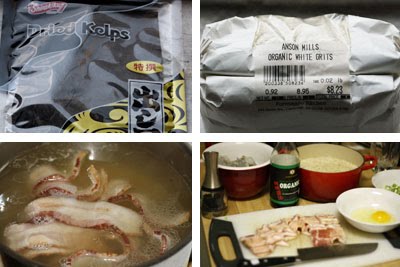
Shrimp & Grits, Momofuku Style


Having spent equal parts of my life in the Southeast and the Northeast, I was eager to make the recipe for shrimp and grits from the Momofuku cookbook.  Keeping the central components of the classic Southern dish intact while adding a small dash of New York edge, Momofuku's shrimp and grits achieves the right blend of North vs. South, something this blogger has been trying to achieve his whole confused life.  As difficult as it can sometimes be to tame New York 'tude with Southern charm, David Chang shows that it's pretty easy to do so on a plate. 

The hardest part about this shrimp and grits dish is sourcing the ingredients.  I had the good fortune of finding Anson Mills grits--the same South Carolina grits that Momofuku and seemingly every other higher-end restaurant in America with a grits dish on its menu use--at Formaggio Essex in New York's Essex Street Market.  It's worth it to search these grits out or splurge and order them online; they are the best grits out there, tasting as if the corn used to make them had been shucked just days before the grits were ground.


Aside from the grits, the only other ingredient you need to seek out is konbu, or dried kelp, that goes into the Bacon Dashi in which you boil the grits.  Fortunately, New York has no shortage of Japanese markets that carry konbu, but if you can't find it, you should be able to get by with boiling the grits in chicken broth. 

Ingredients and some splattering grits aside, this Momofuku's dish is easy to pull off.  Boil the grits, stir in a stick of butter (I didn't say this was healthy), cook the bacon, sautè the shrimp, poach some eggs, and stir it all together with a few splashes of soy sauce and some scallions and you have an excellent, North-meets-South-meets-Far-East meal.

Monday, April 26, 2010

Shrimp Rolls from Luke's Lobster


With great excitement, I discovered that Luke's Lobster, a lobster roll shack in the East Village known for serving one of Manhattan's least expensive lobster rolls, is opening a larger restaurant just a short walk south of my apartment.  It is rare that a restaurant that is both newsworthy and wallet-friendly opens on the Upper East Side, so I am eagerly counting down the days until Luke's arrival.  Nonetheless, Significant Eater and I could not resist a recent craving for buttery seafood served in a toasted hot dog bun, so we decided to make Luke's shrimp rolls at home, thanks to this recipe from New York magazine.  All the credit for the shrimp rolls goes to Significant Eater, who briefly earned the slightly more functional but no more lovable name of Significant Cook for making these beauties.  She had the great idea to top each roll with a dash of Old Bay Seasoning, which we are pretty sure is done at the restaurant but is omitted from the recipe.  For one night only, my studio turned into a seafood shack... well maybe not quite that big.      

Sunday, January 31, 2010

Spaghetti with Creamy Tomato and Shrimp Sauce


For this recipe, I tweaked a Marcella Hazan recipe by substituting canned San Marzano tomatoes where she called for tomato paste.  Nonetheless, the recipe results in a creamy pink sauce that is full of shrimp flavor in every bite.  Don't skip the step to make the shrimp paste; cleaning your food processor after pureeing shrimp is not an enjoyable task, but the shrimp paste is essential to making the sauce taste like a shrimp sauce rather than just a creamy tomato sauce that happens to have a few shrimp scattered about.

Spaghetti  with Creamy Tomato and Shrimp Sauce
Serves 4

Ingredients:
  • 1/2 lb medium shrimp, shelled and de-veined
  • 1/3 cup olive oil
  • 2 garlic cloves, thinly sliced
  • 1/4 cup dry white wine
  • 1 28 oz. can whole tomatoes, crushed by hand
  • salt and pepper, to taste
  • 1/2 cup heavy cream
  • 1 lb spaghetti
  • 2 tbsp parsely, finely chopped


Directions:
  1. Cut the shrimp in half lengthwise and set aside.
  2. Heat the olive oil over medium heat.  Add the garlic and cook until it turns light gold.  
  3. Add the wine and tomatoes to the pan and bring to a boil.  Reduce the heat to a gentle simmer.  Cook the tomato sauce, stirring occasionally, until it is thick and all of the ingredients are well-combined. about 30 minutes.  
  4. Add the shrimp, salt, and pepper to the tomato sauce and bring the sauce to a gentle boil.  Cook, stirring frequently, until the shrimp are cooked through, about 2 minutes.  Reduce the heat to medium. 
  5. Using a slotted spoon, remove 2/3 of the shrimp from the pan and puree them in a food processor.  Return the pureed shrimp to the pan and stir the sauce well to combine.  
  6. Add the cream to the sauce and cook, stirring frequently, until the sauce thickens, about 2 minutes.  Taste the sauce for salt and pepper.
  7. Meanwhile, cook the spaghetti according to the package's directions.  Drain the pasta well and add it the tomato sauce.  Stir the pasta well to coat it with sauce.  Serve immediately, garnished with the chopped parsley.

Tuesday, December 22, 2009

Shrimp with Caramel Sauce


It's always nice when an ambitious-sounding meal can be created by simply using some leftover bits in the fridge. In this case, I simmered shrimp in some of the Vietnamese caramel that I had made several weeks ago for pork ribs. These shrimp are not nearly as sweet as the caramel sauce title may lead you to believe. While I do cut the cooking time from what is called for in Andrea Nguyen's Into the Vietnamese kitchen, you still need to cook the shrimp for longer than you think in order to allow the flavors of the sauce to penetrate the meat.

Shrimp Simmered in Caramel Sauce
Adapted from Into the Vietnamese Kitchen

Ingredients:

  • 1 lb shrimp, peeled and deveined
  • 1 1/2 tbsp fish sauce
  • 2 tbsp Vietnamese caramel sauce (recipe here)
  • 1 yellow onion, thinly sliced
  • large pinch of black pepper
  • 1 tbsp canola oil
  • 1 scallion, green part only, thinly sliced

Directions:

  1. In a small dutch oven, combine the shrimp, fish sauce, caramel, onion, and pepper. Bring to a rapid simmer over medium-high heat, stirring occasionally, until the shrimp are the color of clay and the sauce is almost completely reduced, about 8 minutes.
  2. Remove the pan from the heat and toss the shrimp in the oil. Garnish the shrimp with the scallion and serve with white rice.

Sunday, November 29, 2009

Seared Scallops over Braised Leeks


The sweet, briny flavor of sea scallops makes them pair nicely with earthy foods such as mushrooms and leeks. Last night, I served scallops that I had purchased at the Union Square Greenmarket with leeks that I simply braised in chicken broth with thyme and bacon. A good scallop needs little more than butter and maybe a squeeze of lemon, and that's exactly what I did with these scallops, which had been caught off the Long Island shore the same morning that I purchased them. The key is to dry the scallops thoroughly prior to searing them in clarified butter (clarified so that butter does not burn). Two to three minutes per side on medium-high heat is all you need to give the scallops a wonderful crust on their exteriors.

Tuesday, October 27, 2009

Getting by with a little help from The Flavor Bible

My favorite reference for week night recipes is not a cookbook at all, but rather a book containing lists of ingredients. That book is Karen Page and Andrew Dornenburg's The Flavor Bible, a guide every ingredient imaginable and the flavors and foods that pair well with those ingredients. With limited time and energy to shop or flip through cookbooks during the week, The Flavor Bible has helped inspire many of my week night meals.

The Flavor Bible came through for me once again this week. On a whim, I went to the store bought Spanish mackerel, a fish I had never prepared before. My only existing knowledge of Spanish mackerel was that it was an incredibly oily fish. Having no idea how to prepare my mackerel or what to serve it with, I turned to The Flavor Bible, which suggested, among many other ingredient combinations, a pairing of mackerel with arugula, chickpeas, and lemon, all of which were ingredients that I had on hand.

Going with The Flavor Bible's suggestion, I drained my can of chickpeas and placed them in a small pan where I had heated a few spoonfuls of olive oil over low heat. I seasoned the chickpeas with salt and pepper. Then, I heated some more olive oil in a skillet over medium-high heat and seasoned the mackerel with salt and pepper. I cooked the mackerel for two minutes per side. Moving back to the chickpeas, I added a few handfuls of arugula and let them wilt. I then finished the chickpeas with a splash of sherry vinegar, another recommendation from The Flavor Bible. I sprinkled lemon juice over both the mackerel and the chickpeas and enjoyed every bit of each. All thanks to The Flavor Bible.

Thursday, October 22, 2009

Squid Ink Risotto with Squid and Shrimp


For most guys, when their girlfriends' birthdays roll around, they agonize about what to give. I agonize about what to cook. When the Significant Eater's birthday came up this week, I wanted to cook a meal that would wow both her and me yet would not be time consuming to make, so that I could minimize the time I spent in my kitchen preparing and cleaning up the meal.

The dish I decided upon was squid ink risotto, a dish that I had enjoyed many times at Bobby Flay's dearly departed Spanish restaurant Bolo. The combination of intensely briny squid ink and comforting, soft risotto is a beautiful contrast. Plus, the jet black risotto set on a white plate makes a very sexy and modern aesthetic.

My only concern about the dish is that it might be too complicated. I have cooked risotto several times before, and aside from the constant stirring, I find it to be a relatively simple preparation. However, cooking with squid ink just sounds disastrous, especially with my none-too-dexterous hands. I could not help but think of my apartment becoming a rendering of the Cream song "White Room," all from a squid ink risotto gone awry. Sixties psychedelia was definitely not the type of sexy I was going for with this meal.

Fortunately, squid ink is not anymore difficult than any other risotto. First, simmer some shrimp stock mixed with a few spoonfuls of squid ink. Then, saute some aromatics (minced onion and garlic are the best) in a sauce pan. Add the rice, and let it cook for a couple of minutes. Add a glass of white wine to the pan and let it cook off. Then, add a ladle of the stock to just barely cover the rice and start stirring. Once the rice has absorbed all of the stock, add another ladle of stock and let the rice soak it up once again. Continue the process until the rice is perfectly soft, just slightly beyond al dente. Add the squid and cook for another few minutes. Stir in salt, pepper and parsley, to taste, and you have a wonderful dish of squid ink risotto.

Squid Ink Risotto
Serves 4

Ingredients:
  • 6 cups shrimp stock
  • 2 tbsp squid ink
  • 3 tbsp olive oil
  • 3 garlic cloves, minced
  • 1 yellow onion, finely chopped
  • 2 cups Arborio rice
  • 3/4 lb squid, cut into 1/4 inch rings (full tentacles are okay, too)
  • 1/4 cup parsley
  • salt and pepper to taste

Directions:
  1. Mix stock and squid ink in a large sauce pan. Heat over medium heat and bring to a gentle simmer. Stir occasionally to prevent the squid ink from congealing (just stir vigorously if it does).
  2. Meanwhile, heat olive oil in a medium sauce pan over medium heat. Add onion and garlic and cook, stirring occasionally, until they are soft and fragrant, 3 to 5 minutes.
  3. Add the rice to the onion and garlic and stir to coat the rice with oil. Let the rice cook until it begins to pop, about two minutes.
  4. Ladle in enough shrimp stock to barely cover the rice. Adjust the heat to keep the stock at a simmer. Stirring constantly, let the rice absorb the stock. Once the rice has absorbed the stock, ladle in more stock to cover the rice again and continue to stir until the rice has absorbed the stock. Repeat the process until the rice is soft and creamy.
  5. Stir the squid into the rice and cook until the squid is cooked through, approximately 2 minutes.
  6. Stir in the parsley and season with salt and pepper. Serve immediately, topped with grilled, steamed, or sauteed seafood of your choosing.

Monday, October 19, 2009

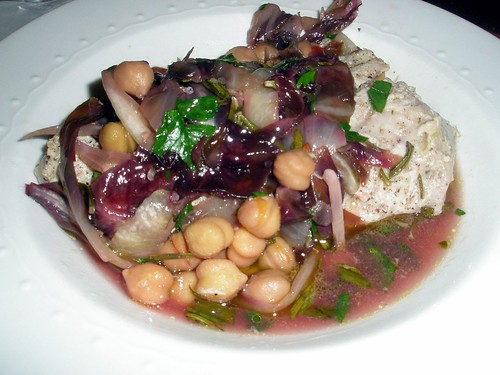
Braised Tuna with Radicchio, Chickpeas, and Rosemary


The other day, I made Braised Tuna with Radicchio, Chickpeas, and Rosemary from Molly Stevens' wonderful All About Braising. Braising may sound like a terrible way to cook a nice piece of tuna, but the recipe works beautifully. The key is to keep the braising liquid at the gentlest of simmers, cooking the tuna just enough so that it remains pink on the inside. I cooked two 1.25 inch thick steaks for 8 minutes. The braising liquid is infused with the strong flavors of rosemary and radicchio, and the chickpeas lend the dish additional heartiness. This is an easy one pot meal, with the only necessary accompaniment being a baguette to soak up the delicious sauce.

Sunday, August 16, 2009

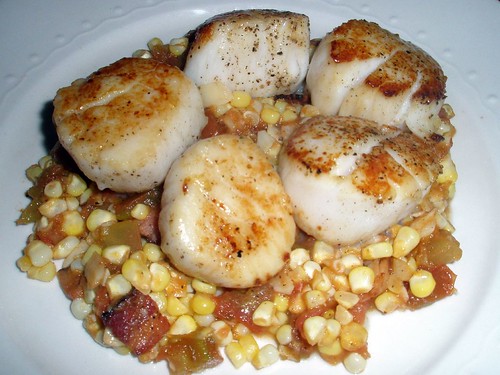
Scallops with Sauteed Corn, Tomatoes and Bacon

This weekend, I cooked what I think is my greatest success with a recipe of my own creation. Sticky from 90 degree weather, and in no mood to spend too much effort cooking a meal for myself, I ventured to the store with not one idea in mind. I made a quick glance at the butcher counter, but I save simple pork and chicken dishes for the weekdays, and I did not feel like beef. Taking the weather into account, the seafood counter seemed like the best bet, but I had had fish the night before. Nearly ready to leave the store and scan through the list of dreadful takeout places in my neighborhood, I spotted some beautiful and well-priced Montauk sea scallops sitting in the far corner of the seafood counter. Knowing full well that this would be the perfect opportunity to take advantage of the scallop-hating Significant Eater being out of town for the weekend, I purchased five scallops. Let me tell you, I'm a scallop-izer, and I get pretty out of control when the Significant Eater is not around.

Scallops in my bag, I began to think of how I could prepare them. I thought of the items that needed to be eaten in my refrigerator before they went bad. I had an ear of corn purchased from the Greenmarket a few days ago, half an heirloom tomato leftover from a BLT earlier that day, and a package of bacon, which wasn't going bad, but bacon is always in my thoughts. Scallops, corn, tomato, and bacon sounds like something on a restaurant menu, I thought, so I went with the idea. I am glad I did, for in my mind, the dish could not have been improved upon. The corn, bacon, and tomatoes came together very nicely, and provided a perfect bed for the sweet scallops to rest upon.


Scallops with Sauteed Corn, Tomatoes, and Bacon
Serves 2

Ingredients:
  • 2 slices of bacon, diced
  • 2 cloves garlic, minced
  • 2 ears of corn, shucked
  • 1 tomato, preferably heirloom, diced
  • Salt and pepper, to taste
  • 8 large sea scallops
  • 2 tbsp olive oil
  • 1 tbsp butter
Directions:
  1. Heat bacon in a deep skillet over medium heat. Cook until fat is rendered and bacon begins to crisp.
  2. Add garlic to skillet and cook until fragrant but not browned, no more than two minutes.
  3. Add tomato and corn to skillet and cook until tomato begins to break down, about three minutes. Taste for salt and pepper and set heat to low, stirring occasionally.
  4. Prepare the scallops by tearing off the muscle. Pat them dry with paper towels and season with salt and pepper.
  5. Heat olive oil over in a skillet (preferably cast iron for the perfect sear) over high heat.
  6. Add scallops to the pan. After thirty seconds, reduce the heat to medium. Cook until well seared on one side, about three minutes.
  7. Flip scallops and add butter to pan. Cook for another 3 minutes, occasionally basting scallops with butter.
  8. Serve scallops on plates atop corn, bacon, and tomato mixture.

Sunday, August 2, 2009

Mussels with White Wine, Shallots, and Pancetta


Cooking dinner in my apartment in the summer is always a challenge. No matter whether I use the oven or the stove, my studio will remain about ten degrees warmer for the rest of the night. I can only enjoy so many cold suppers, so I have a few favorite dishes for the summer that are studio-apartment friendly. One of those dishes is steamed mussels. The dish can come together in less than half an hour, and the most time consuming part is scrubbing and debearding the mussels. Making the dish does fill my apartment with the aroma of mussels and butter, but that is much more tolerable in my opinion than a hot apartment.

Feel free to experiment with the ingredients in the recipe. As long as you keep the ratios the same, there is an endless number of possibilities. Substitute Belgian beer for the wine, cream for the butter, or add a mix of herbs to the broth. So long as you serve the mussels with a crusty baguette (heated in the toaster oven, not the oven), you'll have an easy and enjoyable meal in the comforts of your cool apartment.

Mussels with White Wine, Pancetta and Shallots
Serves 2

Ingredients:
  • 2 lbs. mussels, scrubbed and debearded
  • 2 cups white wine
  • 2 large shallots, finely minced
  • 4 garlic cloves, smashed with the side of a knife
  • 2 tbsp. olive oil
  • 1/8 lb. of pancetta, diced
  • 2 tbsp. butter
  • Salt and pepper, to taste
Directions:
  1. Heat olive oil in a large pot over medium heat. Add pancetta and cook until fat is rendered and pancetta begins to brown, about 3 minutes.
  2. Add garlic and shallots and cook until shallots are soft, about 2 minutes. Season with salt and pepper.
  3. Add wine to pot and bring to a boil.
  4. Add mussels to pot and cover. Cook until most of the mussels have opened, about 6 minutes. Remove mussels from the pot and set aside in a large serving bowl, discarding any mussels that have not opened.
  5. Bring liquid in pot to a simmer. Whisk in butter and taste for salt and pepper.
  6. Pour broth over mussels and serve with a crusty baguette.

LinkWithin

Related Posts with Thumbnails