Showing posts with label recipe. Show all posts

Thursday, April 28, 2011

Mako with Fennel and Cherry Tomato Sauce


In just a few month, I will be a broke student, so I have started to be a bit more thrifty when it comes to my food purchases.  The other day, I went to the fishmonger looking for a firm, meaty fish that I could serve with a sauce I intended to make with some fennel and cherry tomatoes I had on hand.  Swordfish seemed like the obvious choice, but when I saw mako, which the fishmonger's sign described as "similar to swordfish," for half the price, the budget-conscious half of my brain told me to give the shark a try.  While I'm not completely sold on mako—the texture of the meat is not quite as firm as that of swordfish nor is it as flavorful—the bright tomato and fennel sauce more than made up for it and made me thankful that I still had a few extra dollars in my pocket.

Mako with Fennel and Cherry Tomato Sauce
Serves 2

Ingredients:
  • 1/4 cup plus 2 tbsp olive oil
  • 1 small yellow onion, diced
  • 1/2 fennel bulb, cored and diced
  • 1/2 tsp fennel seeds, toasted
  • 2 tbsp red wine vinegar
  • 1/2 pint cherry tomatoes, stemmed
  • 2 6 oz. mako or swordfish fillets
  • salt and pepper
Directions:
  1. Preheat the oven to 375F.
  2. Heat the olive oil in a medium saucepan over moderate heat. 
  3. Add the onion, fennel, and fennel seeds to the saucepan and season with salt.  Cook until the onion and fennel soften, about 5 minutes. 
  4. Pour the vinegar into the saucepan and bring it to a boil.  Let the vinegar evaporate completely, about 1 minute. 
  5. Reduce the heat to medium-low and add the tomatoes to the saucepan.  Cook, stirring frequently, until the tomatoes burst, 3 to 5 minutes.  Taste the sauce for seasoning and keep warm over low heat while you cook the fish.
  6. Season the fish with salt and pepper.
  7. Heat 2 tbsp of olive oil in a medium skillet over medium-high heat.  Add the fish and cook until they are golden on one side, 1 to 2 minutes.  Flip and cook until golden on the other side, 1 to 2 minutes.
  8. Put the skillet in the oven and cook until the fish is just cooked through, about 4 minutes.  Do not overcook the fish.
  9. Serve the fish immediately, topped with a generous amount of the fennel and tomato sauce.

Monday, April 25, 2011

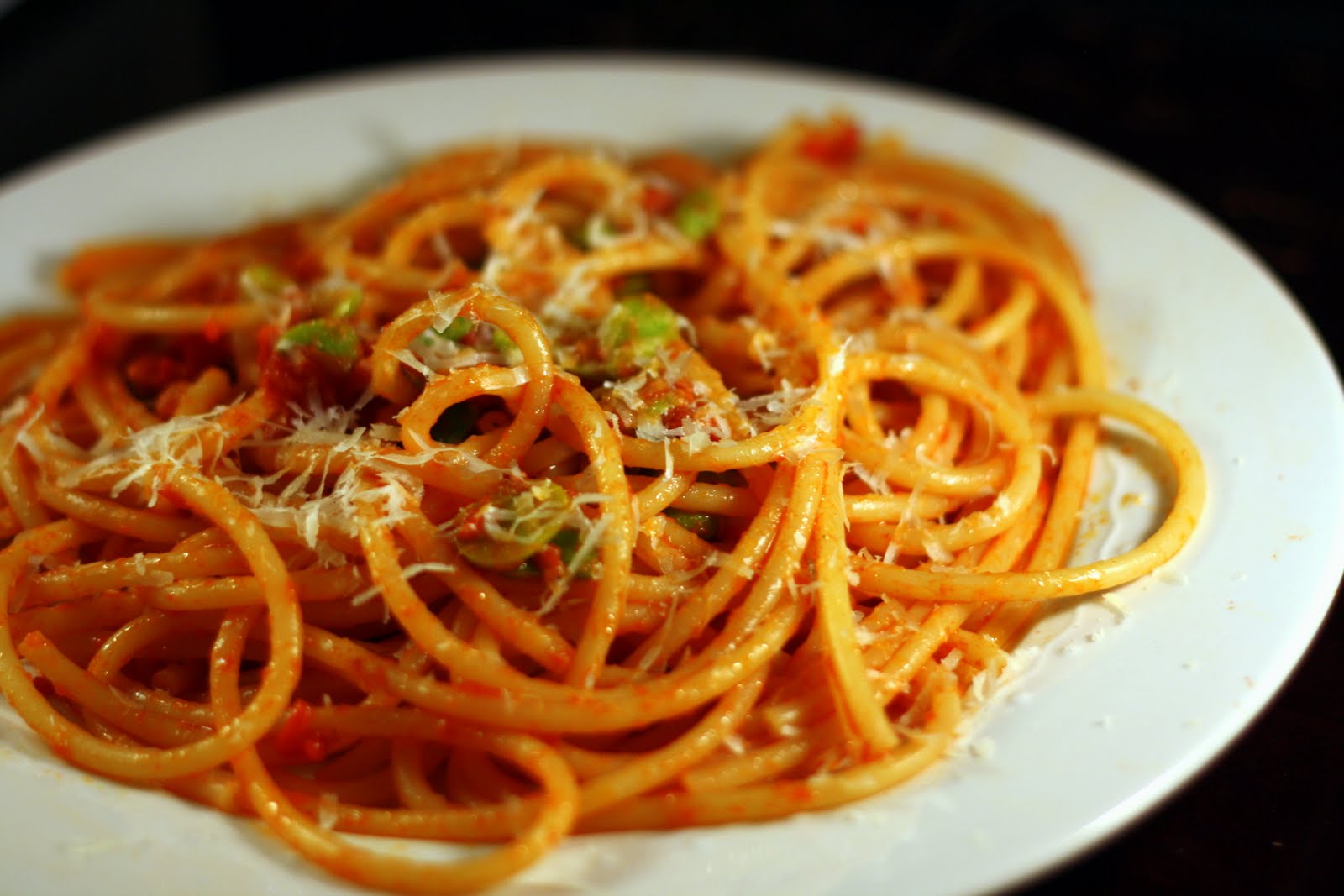
Bucatini with Pancetta, Fava Beans, and Tomato Sauce


Bucatini is my favorite dried pasta.  Nice and thick—about twice as thick as spaghetti—,it has a wonderful texture that allows a sauce coat each tube perfectly. Although bucatini can be difficult to track down, I was fortunate enough to spot some at Eataly.  The traditional method of serving the pasta i is all'Amatriciana, and I decided to go a similar route with the tomato sauce and pancetta, but it being the beginning of spring after a long, harsh winter, I couldn't resist tossing in some blanched fava beans for good measure.  The beans added wonderful texture and color to the buttery tomato sauce and al dente pasta.


Bucatini with Pancetta, Fava Beans, and Tomato Sauce
Serves 4

Ingredients:
  • 2 lbs fava beans, shelled
  • 2 tbsp olive oil
  • 1/4 lb pancetta, diced 
  • 2 cloves garlic, minced
  • 1 cup simple tomato sauce (I used Marcella Hazan's)
  • 1/4 tsp red pepper flakes
  • 1 lb bucatini
  • grated Pecorino Romano cheese, for serving
Directions:
  1. Bring a large pot of salted water to a boil.  Add the fava beans and let cook for 1 to 2 minutes.  Remove the fava beans with a slotted spoon and put them in a bowl of ice water.  Once cool, peel off the skins of the beans and set aside.  Keep the water at a boil.
  2. Add the bucatini to the boiling water and cook for one minute less than the package suggests. 
  3. While the bucatini boils, heat the olive oil in a saute pan over medium heat.  Add the pancetta and cook until it begins to crisp, about 3 minutes.  Add the garlic and red pepper flakes and let it cook until it is fragrant, about one minute.  Add the tomato sauce to the pan and bring to a simmer.  Stir in the fava beans and taste for seasoning. 
  4. Drain the pasta and stir it into the simmering sauce.  Let the pasta and sauce cook for another minute, stirring to ensure that the pasta strands are coated by the sauce.
  5. Serve the pasta in bowls, topped with grated Pecorino Romano cheese.  

Tuesday, April 12, 2011

Scallops with Fava Beans, Dandelion Greens, Ramps, and Pancetta


 This dish hardly requires a recipe, as it consists of little more than the ingredients listed in the title.  That's what I love about spring produce; it is so delicious on its own that gussying it up with any other ingredients usually does more harm than good.  In this case, I've paired seared jumbo sea scallops with blanched fava beans and dandelion greens, ramps, and crispy pancetta that I have sauteed in a bit of olive oil.  A drizzle of sherry vinegar, a few cracks of salt and pepper, and you have spring on a plate.

Scallops with Fava Beans, Dandelion Greens, Ramps, and Pancetta
Serves 2

Ingredients:
  • 1 lb. fava beans, shelled
  • 2 tbsp
  • 1/4 lb. piece of pancetta, diced
  • 1 bunch of ramps, cleaned, trimmed and cut into 1/4-inch pieces
  • 1 bunch of dandelion greens, cleaned and trimmed
  • 8 large sea scallops
  • salt
  • pepper
  • 1 tbsp butter
  • Sherry vinegar
Directions:
  1. Bring a large pot of salted water to a boil.  Add the shelled fava beans to the water and boil for 2 minutes.  Immediately drain the favas and add them to a bowl of ice water to cool.  Once cooled, peel each fava and place the beans in a bowl.
  2. Heat a tablespoon of olive oil in a large skillet over medium heat.  Add the pancetta and cook, stirring occasionally, until the fat renders and the pancetta begins to crisp.  Add the ramps and cook until some of the pieces begin to brown.  Add the dandelion greens and cook until they begin to wilt.  Season with salt and pepper and drizzle a bit of Sherry vinegar over the greens. 
  3. Meanwhile, as the dandelion pancetta cooks, prepare the scallops.  Pat them dry with a paper towel and season them with salt and pepper.  Heat a tablespoon each of olive oil and butter in a large skillet over high heat.  Add the scallops and cook, undisturbed, until they are well-browned on one side, about 2 to 3 minutes.  Flip the scallops and cook on the other side until it is well-browned, another 2 to 3 minutes.  Set the scallops aside on a plate.
  4. To plate the dish, divide the ramps and dandelion greens among two plates.  Quickly heat the fava beans in one of the skillets just until they are hot and surround the greens with the beans.  Top the greens with the scallops.  Serve immediately.

Sunday, April 10, 2011

Ricotta Gnocchi


I made gnocchi once before, and while they weren't bad for a first attempt, they were not the light and fluffy pillows of pasta that I crave when I think about gnocchi.  Nearly two years later (time sure does fly, doesn't it!), I have made another attempt at gnocchi, and I think I finally figured it out this time around.  The key is to have extremely delicate touch when handling the dough.  As someone who has never been known for having a light touch—watch me do ten layups on a basketball hoop you'll see what I mean—I found this to be easier said than done. But just remind yourself every step of the way to have gentle hands, combining the ingredients of the dough just enough and rolling the dough as delicately as possible, and you will be well on your way to perfect gnocchi.  If my clumsy hands can do it, great gnocchi is certainly within anyone's reach.

Ricotta Gnocchi
Adapted from A16: Food + Wine
Serves 4

Ingredients:
  • 2 cups fresh sheep milk ricotta cheese
  • 2 tbsp olive oil
  • 3/4 tsp salt
  • 1 egg yolk
  • 1 egg, lightly beaten
  • 1 cup "00" pasta flour or all-purpose flour, plus more as needed
  • 1/2 cup semolina flour
Directions: 
  1. In a large bowl, combine the ricotta, olive oil, and 3/4 tsp salt.  Taste the mixture for seasoning and add more salt if necessary.  It should be fairly salty since the flour will even out the salt level.  
  2. Stir the ricotta mixture until it is smooth in appearance, with no large curds visible.
  3. Stir in the egg yolk and half of the beaten egg and stir until just combined.
  4. Find a large, clean work surface and coat it with 1/2 a cup of the "00" pasta flour.  Spread the ricotta mixture on top of the flour, and top it with the remaining 1/2 cup of "00" pasta flour.
  5. Using your hands, gently fold the flour onto the ricotta mixture.  Continue to do so just until the dough comes together.  The dough should be slightly sticky, but should not stick to your fingers.  If it is too sticky, fold in a bit more flour.  
  6. Lightly dust a large cutting board or other large work surface with semolina flour.  
  7. Divide the gnocchi dough into 6 pieces.
  8. Take one piece of the gnocchi dough and, using a very gentle touch, roll it in the semolina flour until it forms a long long about a 1/2 inch in diameter.  Repeat with the remaining pieces of dough.
  9. Using a sharp knife or pizza cutter, cut each log of dough into 1-inch pieces.  At this point, the gnocchi can be cooked or frozen for a later use.
  10. To cook the gnocchi, bring a large pot of salted water to a boil.  Add the gnocchi and wait for the pasta to float in the water, about two minutes; let the gnocchi cook for an additional minute after they float.  Using a mesh strainer, remove the gnocchi from pot.  Serve immediately with the sauce of your choice.  Pesto or a simple tomato sauce work particularly well.

Sunday, February 27, 2011

The Final Countdown begins with Pho


 I recently received the exciting news that I will be leaving New York in six months to become a full-time student for the next two years in a place that is a very far cry from New York.  While I am ecstatic to begin this new chapter in my life, I am going to be sad to leave behind all the people, places, and activities that have made my five years in New York so special, so like a person who's been told he has six months to live (and for me, the thought of enduring two years of cafeteria food and microwave dinners feels a bit like that), I have created a list of things to do before I leave this great city.  While my list includes a lot of special, only in New York activities (picnic in Central Park, run around the island of Manhattan), it also includes a category of items that most New Yorkers would not dare do: "Challenging Foods to Cook!"  In six months, I'll not only to be kitchen-less, but I'll also have limited time to do much cooking, so I have decided to try to make an effort all those foods that I have always wanted to make, but never made the time or the effort to cook.

First up on my cooking list was pho, the Vietnamese soup.  After making it, I realized that making pho is not at all the challenge I assumed it would be, although after about four hours of preparing it plus a couple more hours wandering the streets of Chinatown in search of the right ingredients, a $5 bowl at a pho joint seems like an even better deal.  I made pho bo, or beef pho, using thin slices of cooked brisket and raw sirloin, but the technique for pho ga (chicken pho) is fairly similar.


The first step to a great pho is to char the skins of the onions and ginger that go into the broth.  If you don't have a hood or a well-ventilated kitchen, it's best to do this step under a broiler or outside on a grill.  If you do, or you don't like me, but know you will be moving out of your apartment in six months, you can roast the vegetables over an open flame.  You want to char the ginger and onions completely, about 15 minutes, turning them frequently as they roast.  Once they are done, let them cool down.  Rinse the vegetables under cool water, peeling off the charred skins.


The central component of pho broth is, of course, the beef bones.  I used about 5 pounds of 2-inch thick shin bones. The first thing you'll want to do is to boil the bones in water for a few minutes, which will remove some of the impurities from the bones, allowing for a clearer broth.  Once boiled, drain the bones.


To make the broth, you combine the beef bones, the onions and ginger, a cinnamon stick, a spoonful each of cloves, star anise, sugar, and salt, a generous pour of fish sauce, and thick strips of brisket with six quarts of water.  Allow this mixture to simmer for an hour and a half.  Then, remove the brisket and continue simmering the broth for another hour and a half.  Drain the broth through a fine mesh sieve and refrigerate it overnight so that the fat solidifies.  The following day, remove the fat from the broth.


The day that you plan to serve the pho, prepare all of the condiments and set them on the table.  Lime juice, Thai basil, mint, blanched bean sprouts, Sriracha sauce, and hoisin are all go nicely with pho.

Once the broth is ready, prepare the bowls: boiled rice noodles, scallions, cilantro, thinly slice onions, thinly sliced cooked brisket, and thinly sliced raw sirloin.  Then pour the hot broth on top of it all.  It's perfection in a bowl.


Sunday, February 13, 2011

Cavatelli with Sausage & Browned Sage Butter


 As you may have noticed from the lack of posts on this blog the last few weeks, I have been very busy of late.  When I don't have time to cook, I usually fall into a boring routine of eating leftovers and takeout meals, but I do keep a few super simple recipes up my sleeve that take so little time and make such use of pantry and freezer staples that I have little excuse not to cook when pressed for time.  This pasta dish falls right into that category: store-bought fresh cavatelli (okay, maybe that's not such a pantry staple) tossed in a sausage and sage butter sauce.  The recipe, adapted from The Frankies Spuntino Kitchen Companion & Cooking Manual, which has quickly become a favorite of mine for simple recipes like this one, takes less than 30 minutes to prepare and you'd never know it because it's so full of flavor. 

Cavatelli Sausage & Browned Sage Butter
Adapted from The Frankies Spuntino Kitchen Companion & Cooking Manual

Serves 4

Ingredients:
  • 1 lb. hot Italian sausage links
  • 7 tablespoons butter
  • 10 sage leaves
  • pepper, to taste
  • 1 lb. fresh cavatelli
  • 1 cup grated Pecorino Romano cheese
  • 1/2 cup parsley leaves, finely chopped
Directions:
  1. Bring a large pot of salted water to a boil.
  2. Meanwhile, place the sausages in a large saute pan.  Fill the pan with enough water to come half way up the sausage links.  Heat the pan over medium heat and cook for 10 minutes.  Turn the sausages and cook on the other side for 5 minutes. Remove the sausages from the pan and slice into 1/2 inch slices.  Set the sausage aside.
  3. Melt 1 tablespoon of the butter over medium-high heat in a clean saute pan.  Add the sausage slices and let them cook, undisturbed, until they are well browned on one side, 3 to 4 minutes.  Flip the sausage slices and brown the other side, another 2 to 3 minutes.  Remove the sausage slices with a slotted spoon and place them on a paper towel-lined plate.  
  4. Return the pan to the burner and add the remaining 6 tablespoons of butter, pepper, and sage leaves to the pan.  Stir the butter with a wooden spoon, scraping the bottom of the pan to dislodge any brown bits.  Let cook until it is well browned, about 5 minutes.
  5. Meanwhile, while the butter sauce is browning, place the cavatelli into the boiling water and cook until al dente.
  6. Drain the pasta and add it to the butter.  Stir in the sausage and Pecorino Romano cheese and serve immediately, topping each serving with a pinch of the chopped parsley.

Thursday, January 20, 2011

Red Curry Snapper Soup


I love a traditional Southeast Asian curry made with coconut milk and served over plenty of Jasmine rice.  But if you want to lighten it up and make something that is just as flavorful, you can make curry soup by using pretty much the same ingredients, but subbing out the coconut milk with water, just like I have done here using my recipe for red curry paste.  While I find the curry flavors complement seafood, curries made with coconut milk tend to overpower the fish, so I used the opportunity to make a curry soup with a whole red snapper that I marinated in lime juice.  Although the dish has a soupy consistency, it is best served over a bed of steamed Jasmine rice to sop up all the liquid.


Red Curry Snapper Soup
Serves 4

For the curry paste:
  • 1 tsp cumin seed
  • 1 tbsp coriander seed (use another teaspoon if not using coriander root)
  • 1 tsp white peppercorns
  • 5 dried Thai chilies, seeded and soaked in warm water
  • 1 tsp salt
  • 5 small shallots, thinly sliced
  • 10 garlic cloves, peeled
  • 1 tsp galangal, thinly sliced
  • 1 tbsp lemongrass, thinly sliced
  • 1 tbsp Kaffir lime rind, thinly sliced (discard the green peel and use the white pith)
  • 2 tsp coriander root, finely chopped
  • 1 tsp shrimp paste  
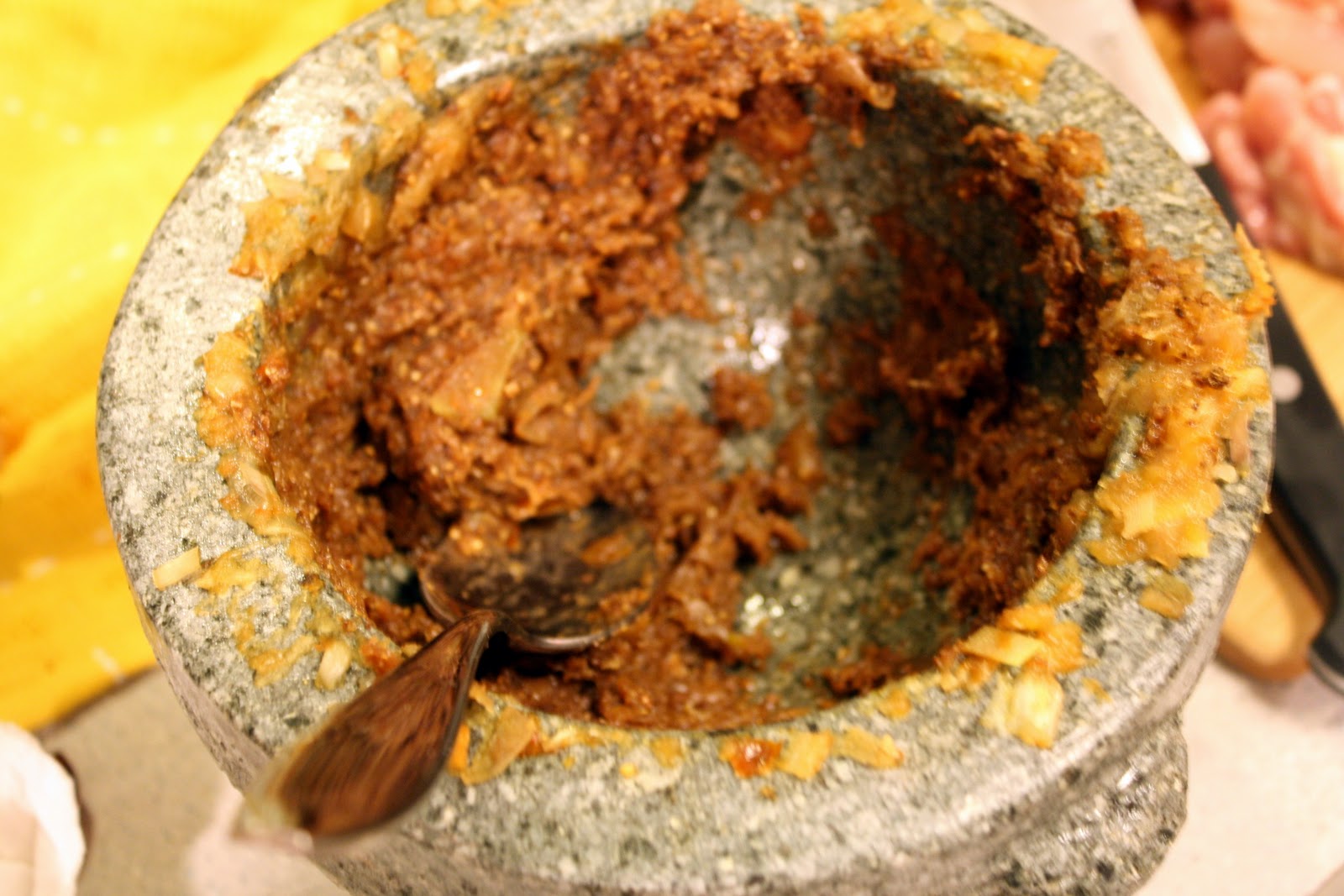
  1. Toast the cumin, coriander seeds, and peppercorns in a dry skillet over medium heat until they are fragrant and begin to pop.  Place them in a mortar and pound them with a pestle until they are finely ground.  Remove the spices from the mortar and set them aside.
  2. Add the dried chilies and salt to the mortar.  Pound the chilies to a paste.
  3. Add the shallots, garlic, galangal, lemongrass, lime rind, and coriander root to the mortar.  Pound the ingredients with the pestle until they form a paste.  
  4. Return the ground spice to the mortar along with the shrimp paste and use the pestle to mix the paste together. 
  5. Set three tablespoons of the curry paste aside for the curry.  The remaining paste can be frozen for up to 6 months. 
For the soup:
  • 1 whole red snapper, cleaned and cut crosswise into 2-inch pieces
  • juice of 2 limes
  • 3 tbsp peanut oil
  • 1 batch curry paste, see above
  • 8 kaffir lime leaves
  • 1 1/2 cup water
  • salt, to taste
  • palm sugar, to taste
  • leaves from 1 bunch of Thai basil
  1. Place the snapper in a nonreactive bowl.  Toss it well with the lime juice and allow it to marinate for 30 minutes.
  2. Heat the olive oil in a large pot over medium heat.  Add the curry paste and cook, stirring frequently so that it does not burn.  Cook until the curry paste is deeply fragrant, about 5 minutes.
  3. Add the snapper, its marinade, the lime leaves, and the water to the pot.  Bring to a gentle simmer and cook, flipping the snapper pieces occasionally, until the fish is cooked through, about 10 minutes.
  4. Add the Thai basil and taste the soup for salt and palm sugar.  Serve immediately.

Thursday, January 13, 2011

Prosciutto-Mozzarella Frittata


Prosciutto, mozzarella, basil, and tomatoes go well together in almost anything, whether it be a pizza, a salad, or a panini.  Frittatas happen to be my favorite vehicle for playing the game of "let me throw a bunch of ingredients together and see what happens," so when I spotted this recipe from Food and Wine for a frittata containing the Italian quartet of ingredients, I couldn't resist.  As expected, they worked flawlessly together even when mixed together with lots of eggs, producing a very filling and satisfying brunch dish.

As a note, I make all of my frittatas using Calphalon's frittata pan, a two skillet set that allows you to flip the frittata without creating a mess.  Given my tendency to be a klutz in the kitchen, the frittata pan has saved me many hours of wiping eggs from my stove and walls.  I highly recommend it.


Prosciutto-Mozzarella Frittata
Adapted from Food and Wine
Serves 6

Ingredients:
  • 10 large eggs
  • 1/4 cup milk
  • 2 tbsp Pecorino Romano cheese
  • 2 tbsp chopped basil
  • 3/4 tsp salt
  • 1/2 tsp pepper 
  • 3 tbsp olive oil
  • 2 medium shallots, thinly sliced
  • 1 plum tomato, cored, seeded, and diced
  • 4 slices prosciutto, cut into strips
  • 4 ounces fresh mozzarella, cubed
Directions:
  1. In a large bowl, beat together the eggs, milk, Pecorino Romano cheese, basil, salt, and pepper.
  2. Heat 2 tbsp of the olive oil in the deep half of a frittata pan over medium heat.  Add the shallots and cook until they soften, 2 to 3 minutes.  Add the prosciutto and tomato and cook for a minute.  Use a spatula to spread the tomatoes and prosciutto across the bottom of the pan so that they are well distributed.
  3. Add the egg mixture to the pan.  Use a spatula to push the cooked pieces of egg to the middle of the pan and allow the uncooked eggs to flow to the outer edges.  Cook for 3 minutes.
  4. Poke the mozzarella cheese into the eggs so that the cubes are evenly distributed.  Continue to cook the frittata until it is nearly set, another 5 to 7 minutes.  During the last 2 minutes of cooking, heat the remaining tablespoon of olive oil in the shallow half of the frittata pan set over medium heat.
  5. Place the shallow pan on top of the deep pan and flip the frittata.  Keeping the shallow pan covered with the deeper pan, cook the frittata for 4 minutes. 
  6. Uncover the shallow pan and continue to cook the frittata until it is completely set, approximately 5 minutes.
  7. Use a spatula to slide the frittata onto a plate and cut it into wedges for serving. 

Sunday, January 9, 2011

Shrimp Wrapped in Pancetta and Sage


 For my weekday meals, I tend to fall into a monotonous rotation of sauteed chicken breasts and pork chops served with not very imaginative pan sauces.  It's not that I especially love these meals (although I have been known to throw together a darn good pan sauce), it's just that after a long day of work, the last thing I want to do is to struggle with a new recipe, so I stick to the familiar.  I'm always excited when I do go out on a limb and discover a new recipe like this one for shrimp wrapped in pancetta and sage that is simple enough for weeknights.  Thanks to my Manhattan stomping grounds, I do have the luxury of having a market between my office and my apartment that sells both very fresh shrimp and high-quality pancetta, so assuming you can find those two components of the ingredient list, this recipe is as easy as it gets.  It is also quite tasty with the shrimp and crispy pancetta creating somewhat of a high-end hot pocket, perfect for eating on the couch after a harrowing day. 


Shrimp Wrapped in Pancetta and Sage
Serves 2 to 3

Ingredients:
  • 1 lb shrimp, peeled and deveined, tails left on
  • pepper
  • 1 bunch sage
  • 1/4 lb pancetta, thinly sliced
  • 1 tbsp olive oil
Directions:
  1. Lay the shrimp out on a cutting board.
  2. Season the shrimp with pepper.  There is no need to salt the shrimp as the pancetta is very salty.
  3. Place a sage leaf on top of each shrimp.
  4. Wrap a slice of pancetta around each shrimp.
  5. Heat the olive oil in a large skillet until just before smoking.
  6. Gently place the shrimp in the skillet.  Cook without disturbing for 2 minutes then flip each shrimp using a spatula.  Cook the other side until the shrimp are pink and no longer translucent, another 1 to 2 minutes.  Remove the shrimp from the pan and serve immediately. 

Thursday, January 6, 2011

Porchetta


As the second weekend of the new year approached, I’m assuming that everyone’s resolutions to eat better are about to be postponed until January 1, 2012.  Who wants chicken breasts and brown rice when you can have a succulent pork shoulder wrapped stuffed with fennel and onions and wrapped with pancetta?  It’s time to fall of the wagon and have some porchetta.


Although the traditional porchetta involves roasting a whole pig, I decided that that may be just slightly too ambitious to do in a studio apartment, so my porchetta only uses meat from shoulder, one of the most flavorful and economical cuts of the pig.  Porchetta comes in many shapes and forms, and I like to keep mine simple so that the meat shines rather than the filling.  The only thing to really focus on is the pork.  Be sure to pick out a well-marbled pork shoulder with a thick fat cap on top which will keep the meat moist throughout the cooking process.  A fatty piece of pork will make falling off the wagon for porchetta all the more worth it. 


Porchetta
Serves 6 to 8

Ingredients:
  • 1 3 to 4 lb. boneless pork shoulder, butterflied
  • salt and pepper
  • 3 tbsp olive oil
  • 1 large yellow onion, thinly sliced
  • 1 fennel bulb, cored and thinly sliced
  • 6 garlic cloves, peeled and smashed
  • 1 tbsp rosemary, chopped
  • 1 tbsp fennel seeds, toasted
  • 1 tbsp black peppercorns, toasted and ground
  • 1/2 cup fresh breadcrumbs
  • 1 egg
  • 1/4 lb. pancetta
Directions: 
  1. Preheat the oven to 350F
  2. Season the pork on all sides with salt and pepper.
  3. Heat the olive oil in a medium skillet over medium heat.
  4. Add the fennel, onion, garlic, fennel, rosemary to the skillet and season with salt and pepper.  Cook, stirring occasionally, until the vegetables are very soft, about 10 minutes. Remove the onion and fennel from the pan and allow to cool to room temperature in a medium bowl.
  5. Once the fennel and onion mixture is at room temperature, mix in the fennel seeds, peppercorns, breadcrumbs, and egg, stirring well to combine.
  6. Tie the pork shoulder with butchers twine, tying knots spaced one-inch apart across the length of the pork shoulder.
  7. Put the pork shoulder in a small roasting pan or large skillet so that the fat cap is facing up. Drape the pancetta on top of the pork loin so that it is entirely covered. You will likely have some pancetta leftover. 
  8. Roast the pork shoulder until the internal temperature in the thickest part of the meat reaches 160F, 1.5 to 2 hours.
  9. Remove the porchetta from the pan and allow it to rest for 10 minutes.
  10. Slice the porchetta in 1-inch thick pieces and serve with the crispy bits of pancetta.  


    Sunday, January 2, 2011

    Lamb Chops with Artichokes, Olives and Capers

    After having this blog for over two years, I've managed to cook a lot of foods that I otherwise might not have attempted if I did not have the blog to keep me searching for challenges.  Artichokes are one ingredient that I had not yet gotten myself to cook.  With their green pineapple-like appearance, they just look like they would be a lot of work to prepare.


    While I like artichokes, I do not love them, and I assumed the effort they would take to cook would outweigh they satisfaction they would bring. However, it being New Year's Day yesterday, I was feeling particularly ambitious despite being slightly under the weather from the previous evening's debauchery.  I had purchased some lamb chops and wanted to do something interesting and festive with them.  I spotted a box of baby artichokes at the store and recalled a recipe in Thomas Keller's Ad Hoc at Home that paired lamb chops with artichokes.  Given my apprehensions about cooking artichokes in the first place, I'm not sure why I even considered a Thomas Keller preparation, which surely would be extremely nitpicky about trimming the vegetables just so and take twice as long as any other recipe; I'll blame my decision on the alcohol from the night before. 


    To my surprise, even going by Chef Keller's precise directions, the preparing the artichokes was no more difficult than peeling a carrot (and a lot less dangerous!).  Trim off the stem.  Cut off the outer leaves at the base. Trim the top 1/2 inch of the artichoke, and then they are ready to cook.  It's exactly as easy as it sounds.  As for the lamb chops, well they went perfectly with the Mediterranean sauce of the artichokes, olives, capers, and tomatoes.  I can only hope that this dish bodes well for 2011.


    Lamb Chops with Artichokes, Olives and Capers
    Adapted from Ad Hoc at Home
    Serves 2

    Ingredients:
    • 6 baby artichokes, cleaned and trimmed as per the instructions above
    • juice of 1 lemon
    • salt and pepper
    • 4 lamb loin chops
    • 3 tbsp olive oil
    • 2 garlic cloves, crushed and skin left on
    • 4 thyme springs
    • 1/2 cup pitted kalamata olives
    • 1 tbsp capers, drained
    • 1/4 cup canned roasted tomatoes
    Directions:
    1. Preheat the oven to 350F.
    2. Put the trimmed artichokes in medium bowl and cover with the water and lemon juice.  Stir the artichokes for a few seconds.
    3. Pour the artichokes and lemon water into a medium sauce pan.  If necessary, pour in additional water to cover.  Add a pinch of salt and place a damp kitchen towel on top of the artichokes to ensure that they remain completely submerged. Bring to a simmer over medium-high heat and cook until the artichokes are completely tender, 10 to 15 minutes.  Remove the artichokes to a medium bowl and add just enough of the cooking water to cover.  Set aside.
    4. Season the lamb chops on both sides with salt and pepper.
    5. Heat the olive oil in a large skillet over medium-high heat.
    6. Add the lamb chops and cook until well-browned on one side, 3 to 4 minutes.  Flip the lamb chops and cook the other side until well-browned, 2 to 3 minutes.  Add the garlic cloves and thyme to the pan.  Baste the chops occasionally with the fat in the pan.
    7. Place the skillet in the oven and cook until the lamb chops are cooked through, about 7 to 8 minutes for medium-rare.  Remove from the oven and allow the chops rest for 5 to 10 minutes. 
    8. While the lamb chops are in the oven, prepare the sauce.  Pour 1 tbsp olive oil in a medium sauce pan and heat over medium heat.  Add the artichokes and cook for about a minute.  Add the olives and capers and cook for another 30 seconds.  Add the tomatoes and cook for another 2 minutes.  Season the sauce to taste with salt and pepper.
    9. Serve the lamb chops immediately, topped with the artichoke sauce. 

    Thursday, December 23, 2010

    Manicotti filled with a Little Something Something


    One of my favorite meals growing up was my mother's manicotti.  I always assumed it just like all the other mom foods we love.  Crepes filled with ricotta cheese and topped with a little tomato sauce.  Easy, right?

    I thought wrong.  After making these lamb-filled crepes this weekend, I now realize that I should have given my mom more credit for her manicotti.  Everything on down to the crepes was easy to prepare, but those pancakes sure were a doozy!  The technique sounded easy enough to me: a little butter in a non-stick pan, swirl the batter around, cook, flip, and cook a bit more.  But after several ugly, broken crepes and more batter over the Significant Eater's stovetop than she wants to know, I realized that I had to make some changes to my crepe technique.  I finally figured that the key to a good crepe is to keep it thin, stupid.  By putting just enough batter to cover the pan, the crepe will nearly cook through so that when you flip it, it will stay in tact.  Once I figure that out, I was a crepe-making machine, turning out a flawless crepe every few minutes.

    Aside from the crepe part, this dish is the simple kind of component cooking I love.  It sounds intricate— braised meat, crepes, tomato sauce#151;but every component can be made well ahead of time.  Even better, you can turn this dish into anything you please by using the flavor profile of your choosing.  While I used braised lamb and flavored the ricotta with mint,  you could try braised pork shoulder and sage-flavored ricotta, or short ribs with rosemary ricotta.  Even crab and parsley ricotta with a pink sauce.  To that end, in order to keep you all on your creative tiptoes, I've made this recipe as ambiguous as possible. 


    Manicotti filled with the Cook's Choice

    Ingredients:

    For the crepes:
    1. 2 cups whole milk
    2. 1 1/2 cups plus 2 tbsp flour
    3. 4 eggs, lightly beaten
    4. 4 tbsp butter, melted
    5. 1/2 tsp salt

    For the ricotta filling:
    • 2 lbs braised meat of your choice, shredded with a fork
    • 1/4 cup herbs of your choice
    • 1/4 tsp red pepper flakes
    • 3 cloves garlic, minced
    • 2 cups good-quality fresh ricotta cheese
    • Tomato sauce of your choice, preferably homemade
    • Pecorino Romano cheese, grated
    Directions:
    1. Mix the crepe ingredients together in a large bowl.  Strain and refrigerate overnight.
    2. Mix together the ingredients for the crepe filling.
    3. Heat the tomato sauce.
    4. Preheat the oven to 375F.
    5. To make the crepes, heat a medium-size nonstick pan over medium heat and brush it with melted butter.  Ladle a quarter cup of the crepe batter into the pan and swirl the batter around so that the bottom of the pan is entirely coated (you want the crepe to be very thin).  Let the crepe cook for 1 to 2 minute until it is nearly cooked through.  Carefully flip the crepe and cook the other side for another minute.  Remove the crepe to a plate.  Repeat this technique with the rest of the batter, stacking the crepes on a plate.  This should make approximately 15 to 20 crepes.
    6. To make the manicotti, fill the center of each crepe with about 1/3 cup of the ricotta filling.  Wrap each crepe and place seam-side down in a greased casserole dish.  
    7. Place the casserole dish in the oven and cook until the sides of the manicotti begin to brown, 7 to 10 minutes.
    8. Top the manicotti with the heated tomato sauce and grated Pecorino Romano cheese and serve immediately.


    Sunday, September 26, 2010

    Project Food Blog Challenge #2: The Classics

    Many thanks to those who voted for my post for Challenge #1 of Foodbuzz's Project Food Blog!  Your votes got me to Challenge #2, "The Classics." The prompt for the second challenge reads:

    How well can you tackle a classic dish from another culture? We're bypassing the French and Italian standards in favor of more challenging cuisines.

    The competition for this challenge will be even tougher, so it's all the more important that everyone vote for their favorite posts.  Voting will commence at 9am EST on September 27.  You can vote for this post via my contestant profile.  Thanks in advance for your votes!

    For the second challenge, I decided to make a traditional Thai red curry, not only because of the challenge the dish would present, but also because I had at least one major doubter in my ability to pull it off.  Those of you who regularly follow this blog are probably aware that the Significant Eater is of Laotian heritage.  Although she loves and reaps the benefits of much of my cooking, she is skeptical any time I try to cook the Southeast Asian cuisine that she grew up eating.  Although I have been successful in past efforts--Significant Eater had been particularly impressed with the authenticity of my larb--, pounding out a curry paste from scratch and making a great curry would at last calm her fears of seeing me in the kitchen with fish sauce and shrimp paste in hand.


    My mission began in Chinatown at Bangkok Center Grocery, the best place in Manhattan to purchase Thai ingredients.  The friendly store clerk, who no doubt had the same misgivings as the Significant Eater when I told him I was making red curry, helped me find many of the ingredients that I would need to prepare the dish: galangal, lemongrass, coriander seed, white Kaffir limes and lime leaves, shrimp paste, bird's eye chilies, Thai basil, palm sugar, and coconut milk.  Unfortunately, the store had sold out of fresh coriander root, so I decided to double the amount of coriander seeds in the recipe and hope for the best (thankfully, it worked out).

     Most importantly, I also purchased a beautiful granite mortar and pestle that would help me pound out a perfectly textured curry paste. I picked up the vegetables I would need for the curry, long beans and Asian eggplant, from another Chinatown grocer, and was on my way home to start cooking.
     

    The most challenging part of making a curry is preparing the curry paste.  Although it can be easily blended in a food processor, using a mortar and pestle will give the curry paste a better texture, and is also a much more Project Food Blog-worthy method.

    The first step is to toast the spices (coriander, white peppercorns, and cumin seeds) in a dry skillet.  I toasted them until they were fragrant and beginning to crackle.  Once toasted, I tossed them into the mortar and pestle and began pounding away.


    The Significant Eater chided me for my apparently weak mortar and pestle skills, letting me know that her 90-year-old grandmother not only makes curry paste faster than I, but also does so using a pestle that is twice as large as mine.  Once I got over my pestle envy, I rolled up my sleeves and began pounding away at the spices with more aggression.


    Once the spices were ground to a fine powder, I set them aside and placed the shallots, garlic, soaked dry chilies, salt, galangal, lemongrass, and Kaffir lime rind in the mortar and once again began pounding them with the pestle.  To say this step was labor-intensive is an understatement; it took over fifteen minutes, with a few breaks in between, before I was able to pound out all of the chunks in the paste. 


    Finally, I added the ground spices and the extremely pungent shrimp paste to the mortar and mixed the paste together.  With a sore arm, I had finally completed the curry paste.  One thing is for sure: if I make curry paste a few times a week, I will no longer need to pay for a gym membership. 

    And another thing that's for sure is that curry paste sure ain't the prettiest.


    Fortunately, once I had prepared the curry paste, the rest of the curry was fairly easy to make.  First, I fried some of the paste in a bit of peanut oil until it was fragrant.  Then, I tossed in the chicken and stir fried it until it was cooked through.  Once done, I added in about half a can of coconut milk along with the long beans and chopped Kaffir lime leaves, and let it all simmer away for several minutes.  I then added the fish sauce, palm sugar, and eggplant and kept everything simmering until the eggplant was soft.  Finally, I tossed in the Thai basil.  The curry was ready!


    I was a bit concerned that the curry was not as red in color as I expected it to be, but it certainly smelled and tasted like a Thai curry.  Of course, the only opinion that mattered was that of the Significant Eater herself.  I watched her with great trepidation as she spooned a small amount of the curry onto her plate and took her first bite.  Silently, she then proceeded to scoop out several more spoonfuls onto her plate.  Finally, she exclaimed, "Perfect!"

    I have a feeling that she'll be allowing me to cook with my fish sauce and shrimp paste more frequently from now on.


    Red Curry Chicken ("gang phet" in Lao)
    Serves 4

    For the curry paste:
    • 1 tsp cumin seed
    • 1 tbsp coriander seed (use another teaspoon if not using coriander root)
    • 1 tsp white peppercorns
    • 5 dried Thai chilies, seeded and soaked in warm water
    • 1 tsp salt
    • 5 small shallots, thinly sliced
    • 10 garlic cloves, peeled
    • 1 tsp galangal, thinly sliced
    • 1 tbsp lemongrass, thinly sliced
    • 1 tbsp Kaffir lime rind, thinly sliced (discard the green peel and use the white pith)
    • 2 tsp coriander root, finely chopped
    • 1 tsp shrimp paste 
    1. Toast the cumin, coriander seeds, and peppercorns in a dry skillet over medium heat until they are fragrant and begin to pop.  Place them in a mortar and pound them with a pestle until they are finely ground.  Remove the spices from the mortar and set them aside.
    2. Add the dried chilies and salt to the mortar.  Pound the chilies to a paste.
    3. Add the shallots, garlic, galangal, lemongrass, lime rind, and coriander root to the mortar.  Pound the ingredients with the pestle until they form a paste.  
    4. Return the ground spice to the mortar along with the shrimp paste and use the pestle to mix the paste together. 
    5. Set three tablespoons of the curry paste aside for the curry.  The remaining paste can be frozen for up to 6 months. 
    For the curry:
    • 2 tbsp peanut oil
    • 3 tbsp curry paste
    • 1 lb. boneless, skinless chicken thighs, cut into bite-size pieces
    • 1 1/2 cups Chinese long beans, chopped into 1-inch pieces
    • 1/2 of a 13.5 oz. can of coconut milk
    • 1 1/2 tsp palm sugar
    • 2 tbsp fish sauce
    • 1 Asian eggplant, sliced into half-moon-shaped pieces
    • 2 fresh Thai chilies, thinly sliced
    • 1/2 cup fresh Thai basil leaves
    1. Heat the peanut oil in a large saute pan with high sides over medium-high heat. 
    2. Add the curry paste to the pan and cook, stirring constantly, until the paste is extremely fragrant, 3 to 5 minutes.
    3. Add the chicken to the pan and increase the heat to high.  Cook, stirring constantly, until the chicken is nearly cooked through, 3 to 5 minutes.  
    4. Reduce the heat to medium and add the coconut milk, long beans, and lime leaves to the pan.  Bring the coconut milk to a simmer, stirring frequently, until it thickens slightly, about 5 minutes.  
    5. Add the palm sugar, fish sauce, chilies, and eggplant to the pan.  Continue to simmer the curry until the eggplant is cooked through, about about 3 minutes.
    6. Taste the curry for seasoning.  If it needs salt, add a small amount of fish sauce.  If it is not sweet enough, add a small amount of palm sugar.  If it is not hot enough, add additional chilies.  
    7. Add the basil leaves to the curry and serve it with steamed Jasmine rice. 

    Monday, September 20, 2010

    Bacon and Corn Risotto


    I love risotto almost as much as I love sweet summer corn, so corn risotto has been on my cooking wish list for some time.  I don't know what took me so long to make it, as it's a truly awesome dish, especially when enhanced with a healthy dose of bacon--corn and bacon are a match made in heaven.  The key to the risotto is the corn broth; you add the entire cob, all of the husk, and even the string to a pot full of water and allow it to simmer for an hour.  What you end up with is a light broth that imbues the risotto with wonderful corn flavor.

    Bacon and Corn Risotto
    Serves 2 to 3

    Ingredients:
    • 2 ears of corn, unshucked
    • 6 cups water
    • salt and pepper
    • 1/4 lb smoky bacon, diced
    • 1/2 yellow onion, diced
    • 1 cup Arborio rice
    • 1/2 cup white wine
    • 1 tbsp butter
    • 1/4 cup freshly grated Parmesan cheese
    Directions:
    1. Shuck the ears of corn, trimming off any browned parts of the husks.  Place the husks and the strings in a large stock pot.  
    2. Remove the kernels from the corn cobs and set them aside in a bowl.  Chop each cob into three equal-sized pieces and add them to the stock pot.
    3. Fill the stock pot with 6 cups of water and bring it to a boil.  Reduce the heat to a simmer and partially cover the pot.  Simmer the corn trimmings for 1 hour.  Season with salt and pepper and keep the corn broth warm.  
    4. Add the bacon to a medium-size saucepan and heat over medium heat.  Cook, stirring occasionally, until the bacon is slightly crispy, about 3 minutes.  Remove the bacon with a slotted spoon and set it aside.
    5. Pour off all but 2 tbsp of bacon fat from the pan and reduce the heat in the pan to medium-low.  Add the onion.  Cook, stirring occasionally, until the onion is soft and translucent, about 10 minutes.
    6. Increase the heat to high.  Add the rice and cook, stirring constantly, until the rice begins to crackle, about 2 minutes.
    7. Pour the wine into the sauce pan.  Stir the contents of the pan constantly until the rice has absorbed all of the wine, 1 to 2 minutes.  
    8. Reduce the heat to medium.  Holding a strainer over the saucepan, ladle in just enough of the corn broth to cover the rice.  Keeping the risotto at a simmer, constantly stir the rice until it has absorbed nearly all of the broth.
    9. Stir the corn kernels into the rice.  Passing the brother through the strainer, add enough to barely cover the rice.  Stir the rice until it has absorbed the broth.  
    10. Continue to add just enough broth to cover the rice and stir it constantly until the rice is soft and the risotto is creamy.  This will require at least 2 cups of broth total. 
    11. Remove the saucepan from the heat.  Stir in the butter and Parmesan cheese.  Season the risotto with salt and pepper and serve immediately.
      

    Monday, September 6, 2010

    Chicken Breasts wrapped in Pancetta and Sage


    I rarely cook chicken breast dishes, especially those that do not contain a flavorful sauce to drown out the blandness of the lean breast.  Despite my misgivings about the the sound of it--sauceless chicken breast wrapped covered with a few leaves of sage and several slices of pancetta-- I was impressed with how this dish turned out.  The pancetta provides the chicken with crunch exterior, and it's amazing how much flavor is packed into each sage leaf.  No need for a recipe here, just season each breast with salt and pepper, cover it with 6 sage leaves, wrap it in 3 slices of pancetta, and saute it in a small amount of olive oil until the chicken is cooked through, about ten minutes per side.  This techique would also work well with shrimp.

    Wednesday, September 1, 2010

    Swordfish with Creamy Basil and Shrimp Tomato Sauce


    I’m still not overly confident when it comes to cooking without a recipe, so I was especially proud of this dish. I asked the Significant Eater what she would like for dinner and she described to me a dish she had eaten on a night out with her girlfriends at Extra Virgin, a quaint Mediterranean restaurant in Manhattan’s East Village. “Monkfish, in a buttery pink tomato sauce, with rock shrimp,” she stated, paraphrasing the surely hunkish waiter who had made the dish so memorable. It sounded easy enough to me, so I went to work. My fishmonger had sold out of monkfish for the day, so I chose the more sustainable swordfish, which I felt would be meaty enough to hold up to the tomato sauce. Similarly, I replaced the rock shrimp with bite-size pieces of larger shrimp. I had a lot of fun simply cooking by taste, sight, and feel: a splash of wine here, a handful of basil there. As the cooking came to a close, I asked the Significant Eater how it looked in comparison to the dish from Extra Virgin. She raised a spoonful of sauce to her lips and exclaimed, “You nailed it!”
    Swordfish with Creamy Basil and Shrimp Tomato Sauce
    Serves 2, with plenty of extra sauce for pasta the following day

    Ingredients:
    • 5 tbsp olive oil
    • 3 tbsp butter
    • 1 28-oz. can whole tomatoes with their juice, crushed by hand
    • salt and pepper
    • ¼ cup dry white wine
    • ¼ cup heavy cream
    • ½ bound medium-size shrimp, peeled and chopped into ½-inch pieces
    • ¼ cup fresh basil, chiffonaded (leaves rolled and thinly sliced)
    • 2 6-oz. swordfish steaks
    Directions:
    1. Heat the butter and 3 tbsp of the olive oil in a saucepan over medium heat.
    2. Once the butter has melted, stir in the crushed tomatoes.
    3. Bring the tomatoes to a boil, then reduce the heat to a simmer. Season with salt and pepper and allow the tomatoes to simmer until the sauce is no longer watery, about 30 minutes.
    4. Pour in the wine and return the sauce to a simmer. Allow the sauce to simmer for another 5 minutes.
    5. Stir in the cream, shrimp, and basil and simmer the sauce until it is thick and the shrimp have cooked through, about 5 minutes. While the sauce simmers, prepare the swordfish.
    6. Season the swordfish steaks with salt and pepper.
    7. Heat 2 tbsp olive oil in a skillet over medium-high heat.
    8. Add the swordfish to the pan and cook undisturbed until browned on one side, about 3 minutes. Flip each steak and cook until the other side has browned, 2 to 3 minutes. Set each swordfish steak on a serving plate.
    9. Taste the sauce for salt and pepper.
    10. Spoon the sauce over each swordfish steak and serve immediately.

    Wednesday, August 25, 2010

    Seared Scallops with Lemon and White Wine


    This scallop dish was my triumph over bachelorhood.  I had come home from having a couple beers with my friends and my first thought was order a big bowl of pad see ew from the neighborhood Thai restaurant.  But as my alcohol-induced laziness wore off, I decided that I would cook the jumbo sea scallops that I had purchased earlier in the day.  I scrambled to the stove, seared the scallops in a healthy amount of oil and butter, splashed in some white wine and lemon juice, and served it all over some wilted arugula.  Dinner was ready within 10 minutes, the whole dish cost less than ten bucks, and it tasted a whole lot better than takeout.  Bachelorhood has never felt so glamorous. 

    Seared Scallops with Lemon and White Wine
    Serves one hungry man

    Ingredients:
    • 4 large (U-10 or bigger) sea scallops
    • salt and pepper
    • 2 tbsp olive oil
    • 1 tbsp butter
    • 1 garlic clove, minced
    • 1/4 cup dry white wine
    • juice from 1/4 of a lemon
    • 2 handfuls of arugula or spinach
    Directions:
    1. Remove the tough muscle from each scallop and pat them dry with a paper towel.  Season the scallops with salt and pepper.
    2. Heat a cast iron skillet over high heat and pour in 1 tbsp of the oil. 
    3. Once the oil is hot, add the scallops.  Cook undisturbed until they are well browned on the bottom, about 2 1/2 minutes.  
    4. Reduce the heat to medium and flip the scallops.  Add the butter to the pan and continue to cook the scallops, basting frequently with the butter, until they are just cooked through, about 1 1/2 minutes.  Remove the scallops from the pan and set them aside on a plate.
    5. Increase the heat to medium-high.  Add the garlic to the skillet and cook until it is fragrant, about 30 seconds.
    6. Pour the wine into the skillet and bring it to a boil.  Cook until the wine is reduced by half, approximately 2 minutes.  
    7. Meanwhile, as the wine reduces, wash the arugula. Heat 1 tbsp of the oil in a saute pan over medium-high heat.  Add the arugula and a pinch of salt to the pan and cook, stirring frequently, until it begins to wilt, 1 to 2 minutes.  Remove the arugula from the pan and set it aside on a serving plate. 
    8. Remove the skillet with the white wine from the heat and pour in the lemon juice.  Taste the sauce for salt and pepper. 
    9. Top the arugula with the scallops and pour the white wine lemon sauce over the scallops.  Serve immediately. 

    Monday, August 23, 2010

    Pork Cheek Ravioli with Brown Butter Sage Sauce


     The inspiration for this dish began at Dickson's Farmstand Meats, which has become my butcher of choice in New York, not only for its dedication to selling humanely raised meats from local farmers, but also for the more esoteric cuts of meat that it sells.  It was at Dickson's that I spotted a sign for pork cheeks, and, as is the case with most meats that I am utterly clueless about cooking, I could not resist purchasing a pound of them.


    The one thing that I did know about pork cheeks was that they are a tough cut best suited to braising.  However, it being mid-August, a heavy braised dish was not exactly tempting.  I thought about making a pork cheek ragu, but that seemed too much within my comfort zone; I needed to do the pork cheeks some justice.  Staying on the pasta path, I decided that a ravioli stuffed with braised pork cheek would be the perfect way to serve pork cheeks in the summer.  The one problem was that I do not own a pasta maker.  However, I remembered hearing that it was possible to make ravioli using wanton wrappers, and that is exactly what I did.


    The results could not have been better.  The braised pork cheeks required three hours of braising time before they were meltingly tender.  Surprisingly, the delicate wanton wrappers were a pretty close substitute for freshly made pasta.  To ensure that the pork cheeks kept the lead role in the dish, I topped the pasta with a simple brown butter sage sauce, which I brightened with lemon juice to pare down the richness of the pork.  On my way home from the butcher, I had been worried about how I would manage to ruin the pork cheeks, but I can't imagine having them any better way. 


    Pork Cheek Ravioli with Brown Butter Sage Sauce
    Serves 4 

    For the pork:
    • 1 lb. boneless pork cheeks
    • salt and pepper
    • 2 tbsp olive oil
    • 2 cloves garlic, minced
    • 1 carrot, finely diced
    • 1 medium yellow onion, finely diced
    • 1/2 cup dry red wine
    • 1/2 cup canned diced tomatoes with their juice
    • 1 cup chicken stock
    • 1 bay leaf
    • 1 tsp fresh thyme leaves
    • 1/2 tsp dried red pepper flakes
    For the pasta:
    • 20 wanton wrappers
    • 4 tbsp unsalted butter
    • 10 sage leaves
    • juice from 1/2 lemon
    • salt and pepper
    • grated Pecorino Romano cheese, for serving
    Directions:

    For the pork (can be made one day ahead):
    1. Preheat the oven to 275F.
    2. Pat the pork cheeks dry with paper towls.  Season with salt and pepper.
    3. Heat the olive oil in a medium braising dish over medium-high heat.  Add the pork cheeks without crowding (cook in batches if necessary), and saute until well-browned on both sides, about 2 minutes per side.  Set the pork cheeks aside on a plate.
    4. Reduce the heat to medium and add the garlic, carrot, and onion.  Cook, stirring occasionally, until the vegetables soften and begin to brown, 5 to 10 minutes.
    5. Add the wine and bring it to a boil.  Reduce the wine by half, about 3 minutes.
    6. Pour in the tomatoes, stock, bay leaf, thyme, and pepper flakes.  Bring the liquid to a boil, then reduce the heat to a simmer.  Add the pork cheeks and any juices that have accumulated on the plate.  Season the dish with salt and pepper. 
    7. Cover the braising dish and place it in the oven.  Cook, flipping the pork the until the the pork cheeks can be easily shredded with a fork, approximately 3 hours.
    8. Remove the pork cheeks from the braising dish and set them aside on a plate.  If necessary, reduce the braising liquid so that it has almost a syrup-like consistency.  Season with salt and pepper. 
    9. Shred the pork cheeks with a fork and return to the braising liquid. Gently warm the dish prior to filling the ravioli.
    For the pasta:
    1. Bring a large pot of salted water to a boil.  Reduce the heat to a steady simmer (any more than a simmer will break the ravioli).
    2. Lay each of the wanton wrappers on a large flat surface.  Using a brush or your finger, wet the edges of half of the wrappers.  
    3. Place approximately 1 tbsp of the braised pork, with a bit of the braising liquid, on the ravioli with wet edges. 
    4. Place the remaining wanton wrappers over the pork, forming the ravioli.  Press down on the edges of each ravioli with your fingers to ensure that the edges stick together.  
    5. Use a fork to press down on the edges of each ravioli to form ridges.
    6. Place the ravioli in the pot of simmering water one at a time to ensure that they do not stick.  Cook until the ravioli float to the top of the water, approximately two minutes.  Carefully remove each ravioli from the pasta water with a slotted spoon.  Place 5 ravioli on each plate.
    7. As the ravioli cook, make the sauce by heating the butter over medium heat.  Once the butter has melted and begins to brown, remove it from the heat.  Stir in the sage leaves and lemon juice and taste for salt and pepper.  
    8. Pour a few spoonfuls of the brown butter sage sauce over the ravioli.  Top each plate with a small amount of grated Pecorino Romano.  Serve immediately. 

    LinkWithin

    Related Posts with Thumbnails