Wednesday, August 25, 2010

Seared Scallops with Lemon and White Wine


This scallop dish was my triumph over bachelorhood.  I had come home from having a couple beers with my friends and my first thought was order a big bowl of pad see ew from the neighborhood Thai restaurant.  But as my alcohol-induced laziness wore off, I decided that I would cook the jumbo sea scallops that I had purchased earlier in the day.  I scrambled to the stove, seared the scallops in a healthy amount of oil and butter, splashed in some white wine and lemon juice, and served it all over some wilted arugula.  Dinner was ready within 10 minutes, the whole dish cost less than ten bucks, and it tasted a whole lot better than takeout.  Bachelorhood has never felt so glamorous. 

Seared Scallops with Lemon and White Wine
Serves one hungry man

Ingredients:
  • 4 large (U-10 or bigger) sea scallops
  • salt and pepper
  • 2 tbsp olive oil
  • 1 tbsp butter
  • 1 garlic clove, minced
  • 1/4 cup dry white wine
  • juice from 1/4 of a lemon
  • 2 handfuls of arugula or spinach
Directions:
  1. Remove the tough muscle from each scallop and pat them dry with a paper towel.  Season the scallops with salt and pepper.
  2. Heat a cast iron skillet over high heat and pour in 1 tbsp of the oil. 
  3. Once the oil is hot, add the scallops.  Cook undisturbed until they are well browned on the bottom, about 2 1/2 minutes.  
  4. Reduce the heat to medium and flip the scallops.  Add the butter to the pan and continue to cook the scallops, basting frequently with the butter, until they are just cooked through, about 1 1/2 minutes.  Remove the scallops from the pan and set them aside on a plate.
  5. Increase the heat to medium-high.  Add the garlic to the skillet and cook until it is fragrant, about 30 seconds.
  6. Pour the wine into the skillet and bring it to a boil.  Cook until the wine is reduced by half, approximately 2 minutes.  
  7. Meanwhile, as the wine reduces, wash the arugula. Heat 1 tbsp of the oil in a saute pan over medium-high heat.  Add the arugula and a pinch of salt to the pan and cook, stirring frequently, until it begins to wilt, 1 to 2 minutes.  Remove the arugula from the pan and set it aside on a serving plate. 
  8. Remove the skillet with the white wine from the heat and pour in the lemon juice.  Taste the sauce for salt and pepper. 
  9. Top the arugula with the scallops and pour the white wine lemon sauce over the scallops.  Serve immediately. 

Monday, August 23, 2010

Pork Cheek Ravioli with Brown Butter Sage Sauce


 The inspiration for this dish began at Dickson's Farmstand Meats, which has become my butcher of choice in New York, not only for its dedication to selling humanely raised meats from local farmers, but also for the more esoteric cuts of meat that it sells.  It was at Dickson's that I spotted a sign for pork cheeks, and, as is the case with most meats that I am utterly clueless about cooking, I could not resist purchasing a pound of them.


The one thing that I did know about pork cheeks was that they are a tough cut best suited to braising.  However, it being mid-August, a heavy braised dish was not exactly tempting.  I thought about making a pork cheek ragu, but that seemed too much within my comfort zone; I needed to do the pork cheeks some justice.  Staying on the pasta path, I decided that a ravioli stuffed with braised pork cheek would be the perfect way to serve pork cheeks in the summer.  The one problem was that I do not own a pasta maker.  However, I remembered hearing that it was possible to make ravioli using wanton wrappers, and that is exactly what I did.


The results could not have been better.  The braised pork cheeks required three hours of braising time before they were meltingly tender.  Surprisingly, the delicate wanton wrappers were a pretty close substitute for freshly made pasta.  To ensure that the pork cheeks kept the lead role in the dish, I topped the pasta with a simple brown butter sage sauce, which I brightened with lemon juice to pare down the richness of the pork.  On my way home from the butcher, I had been worried about how I would manage to ruin the pork cheeks, but I can't imagine having them any better way. 


Pork Cheek Ravioli with Brown Butter Sage Sauce
Serves 4 

For the pork:
  • 1 lb. boneless pork cheeks
  • salt and pepper
  • 2 tbsp olive oil
  • 2 cloves garlic, minced
  • 1 carrot, finely diced
  • 1 medium yellow onion, finely diced
  • 1/2 cup dry red wine
  • 1/2 cup canned diced tomatoes with their juice
  • 1 cup chicken stock
  • 1 bay leaf
  • 1 tsp fresh thyme leaves
  • 1/2 tsp dried red pepper flakes
For the pasta:
  • 20 wanton wrappers
  • 4 tbsp unsalted butter
  • 10 sage leaves
  • juice from 1/2 lemon
  • salt and pepper
  • grated Pecorino Romano cheese, for serving
Directions:

For the pork (can be made one day ahead):
  1. Preheat the oven to 275F.
  2. Pat the pork cheeks dry with paper towls.  Season with salt and pepper.
  3. Heat the olive oil in a medium braising dish over medium-high heat.  Add the pork cheeks without crowding (cook in batches if necessary), and saute until well-browned on both sides, about 2 minutes per side.  Set the pork cheeks aside on a plate.
  4. Reduce the heat to medium and add the garlic, carrot, and onion.  Cook, stirring occasionally, until the vegetables soften and begin to brown, 5 to 10 minutes.
  5. Add the wine and bring it to a boil.  Reduce the wine by half, about 3 minutes.
  6. Pour in the tomatoes, stock, bay leaf, thyme, and pepper flakes.  Bring the liquid to a boil, then reduce the heat to a simmer.  Add the pork cheeks and any juices that have accumulated on the plate.  Season the dish with salt and pepper. 
  7. Cover the braising dish and place it in the oven.  Cook, flipping the pork the until the the pork cheeks can be easily shredded with a fork, approximately 3 hours.
  8. Remove the pork cheeks from the braising dish and set them aside on a plate.  If necessary, reduce the braising liquid so that it has almost a syrup-like consistency.  Season with salt and pepper. 
  9. Shred the pork cheeks with a fork and return to the braising liquid. Gently warm the dish prior to filling the ravioli.
For the pasta:
  1. Bring a large pot of salted water to a boil.  Reduce the heat to a steady simmer (any more than a simmer will break the ravioli).
  2. Lay each of the wanton wrappers on a large flat surface.  Using a brush or your finger, wet the edges of half of the wrappers.  
  3. Place approximately 1 tbsp of the braised pork, with a bit of the braising liquid, on the ravioli with wet edges. 
  4. Place the remaining wanton wrappers over the pork, forming the ravioli.  Press down on the edges of each ravioli with your fingers to ensure that the edges stick together.  
  5. Use a fork to press down on the edges of each ravioli to form ridges.
  6. Place the ravioli in the pot of simmering water one at a time to ensure that they do not stick.  Cook until the ravioli float to the top of the water, approximately two minutes.  Carefully remove each ravioli from the pasta water with a slotted spoon.  Place 5 ravioli on each plate.
  7. As the ravioli cook, make the sauce by heating the butter over medium heat.  Once the butter has melted and begins to brown, remove it from the heat.  Stir in the sage leaves and lemon juice and taste for salt and pepper.  
  8. Pour a few spoonfuls of the brown butter sage sauce over the ravioli.  Top each plate with a small amount of grated Pecorino Romano.  Serve immediately. 

Wednesday, August 18, 2010

Spaghetti with Spicy Eggplant Marinara


Having recently signed up for the 2010 Philadelphia Marathon, I can look forward to the three months of early morning runs, chafed nipples, and blood blisters on my toes that comes with readying my body for the 26.2 mile race.  The one good that comes from marathon training--aside from looser-fitting clothes--is that it brings on a constant craving for carbohydrates.  With beer and sweets being somewhat off-limits, I turn to pasta to get my carb fix, so be prepared for many pasta recipes the next few months.

To kick off my training, I made a spicy marinara containing slices of fried eggplant and served it over a plateful of spaghetti.  Don't be intimidated by the fried eggplant; eggplant is one of the easiest foods to fry and creates minimal mess.  Just be sure to leave at least 30 minutes to salt the eggplant so that it releases all of its excess water.  Aside from that step, this dish is quick to prepare, and while I'm still looking for a super food to heal my blood blisters, it at least got me through my run the following morning.

Spaghetti with Spicy Eggplant Marinara
Serves 4

Ingredients:
  • 1 large globe eggplant
  • 1 tbsp kosher salt
  • Canola oil, for frying the eggplant
  • 2 tbsp olive oil
  • 3 cloves garlic, minced
  • 1 28 oz. can peeled tomatoes with their juice, crushed by hand 
  • 2 tbsp parsley, chopped
  • 1 tsp hot red pepper flakes
  • 1 lb spaghetti
  • grated Pecorino Romano cheese, for serving
Directions:
  1. Slice off each end of the eggplant.  Slice it into 1/4-inch thick pieces.
  2. Place the eggplant slices in a colander and toss with 1 tbsp salt.  Let the eggplant sit for at least 30 minutes.
  3. Rinse the eggplant and pat it dry with paper towels.
  4. Pour enough canola oil into a saute pan to come 2 inches up the sides.  Heat the oil to 350F.  
  5. Working in batches, add the eggplant to the pan without crowding or overlapping.  Fry until the eggplant begins is golden on one side, 2 to 3 minutes.  Flip the eggplant slices and fry until the other side is golden brown, another 2 to 3 minutes.  Using a slotted spoon, remove the eggplant to a plate lined with paper towels.  Repeat with the remaining eggplant slices.
  6. Heat the olive oil in a large sauce pan over medium heat.
  7. Add the garlic to the pan and stir until it turns golden, about 2 minutes.
  8. Add the tomatoes, parsley and pepper flakes to the pan and bring the mixture to a simmer.  Season it with salt.  Let the sauce simmer until it thickens to a desired consistency and the oil separates, about 30 minutes.  With about 10 minutes left, begin boiling the pasta as per the instructions on the package.
  9. Chop the eggplant slices into quarter-size pieces.  Add them to the sauce and continue to simmer for another 3 minutes.  Taste the sauce for salt and add more red pepper flakes if desired.
  10. Drain the pasta and add it to the sauce.  Serve the pasta immediately,  topped with grated Pecorino Romano cheese. 

Sunday, August 15, 2010

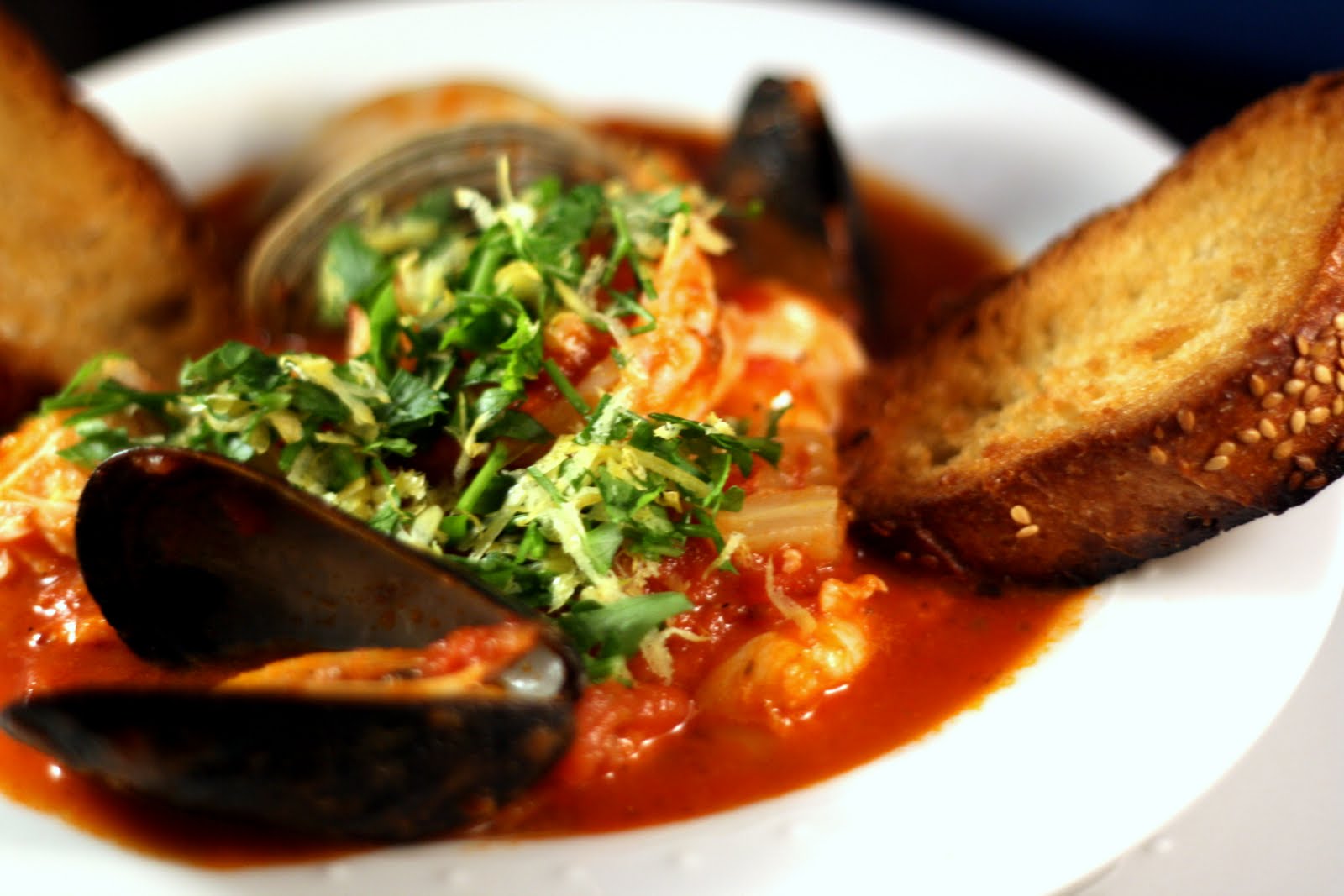
Italian Seafood Stew


 Stew in mid-August? No thank you.  Seafood stew? Well, now that you mention it...

Italian seafood stew, tomato-based and chock full of just about any seafood you want, is one of my favorite dishes that I have made this summer.  I used a recipe from Marco Canora's Salt to Taste, spiking the tomatoes with plenty of lemon and tossing in calamari, little neck clams, mussels, shrimp. and cod.  However, hot summer days are not meant to be spent fretting over recipes, so toss in whatever spices and seafood you like.  Just keep main components the same-- a soffrito of celery, fennel, and onions, a can of crushed tomatoes, a splash of white wine, and some perfectly cooked seafood-- and you are guaranteed a great seafood stew that, when washed down with a crisp white wine, just might take you from a small studio apartment to a beach on the Amalfi Coast.  Unfortunately for this New Yorker, I was quickly awakened from my dream by a truck barreling down Second Avenue, but I plan to revisit it by making this stew at least one more time this summer.   

Wednesday, August 11, 2010

Deviled Pork Chops


 I probably make deviled pork chops every other week.  They take little more effort than plain old pan roasted pork chops, but carry loads more flavor thanks to a coating of dijon mustard and paprika. My recipe is a riff on a Mark Bittman recipe; mine has the addition of paprika and makes a more robust pan sauce than his.  Nonetheless, this is still very much a minimalist recipe and makes for a killer weeknight meal.  For the dish in the picture, I used boneless sirloin chops from Dickson's Farmstand Meats in New York's Chelsea Market, but any sort of pork chops will work just as well so long as you alter the cooking time accordingly.

Deviled Pork Chops
Serves 2

Ingredients:
  • 2 boneless sirloin pork chops, 1" thick
  • Salt and pepper
  • 1 tsp paprika
  • 1 tbsp Dijon mustard
  • 2 tbsp olive oil
  • 1 shallot, minced
  • 1/4 cup dry white wine
  • 1/4 cup chicken stock
  • 1 sprig thyme
Directions:
  1. Season the pork chops on both sides with salt and pepper.  Rub the paprika over the pork chops, then rub them all over with the Dijon mustard.  Set the chops aside.
  2. Heat the olive oil in a 12-inch skillet over medium-high heat.  Once the oil begins to shimmer, add the pork chops.  Cook the pork chops until they are well browned on both sides, about 2 minutes per side.  
  3. Reduce the heat to low and continue to cook the pork chops until they are cooked through, about 3 to 4 minutes per side.  Remove the pork chops to a plate and tent them with foil to keep them warm. 
  4. Increase the heat to medium-high and add the shallots.  Stir them them for 1 minute, then pour in the white wine.  Bring the wine to a boil, using the back of a wooden spoon to dislodge the brown bits at the bottom of the pan.  Let the wine boil until it is almost completely reduced, about 2 minutes.  Pour in the chicken stock and the thyme and bring the liquid to a boil.  Reduce the liquid until it has thickened to a desired consistency, 2 to 3 minutes.  Pour in any liquid that has accumulated on the plate with the pork chops.  Taste the pan sauce for salt and pepper. 
  5. Serve the pork chops immediately with the pan sauce drizzled over top. 

Tuesday, July 27, 2010

Char Siu: Vietnamese Roast Pork Shoulder


Every Sunday, I try to find time to cook a large meal with enough leftovers so that I get to skip out on cooking dinner at least a few nights during the week.  During the cooler months, my go to Sunday night meals tend to be braises.  In the warmer months, I go for roast meats, and my absolute favorite roast meat is char siu, a Vietnamese dish consisting of strips of pork shoulder strips that are marinated in a sweet soy sauce mixture, then roasted at very high heat so that the pork on a beautiful reddish brown color.   Crispy on the outside, with a healthy dose of juicy pork fat interspersed throughout the meat, absolutely no other roast meat beats char siu.  Best of all, unlike the usual monotony that comes with leftovers, leftover char siu lends itself to a wide variety of uses; I have tried it by itself, mixed in with fried rice, and over a bed of noodles.  Each preparation reminded me why I love the dish so much. 


Char Siu
Adapted from Into the Vietnamese Kitchen

Ingredients:
  • 2 lb. boneless pork shoulder, well trimmed
  • 2 cloves garlic
  • 2 tbsp sugar
  • 1/2 tsp Chinese five-spice powder
  • 3 tbsp Hoisin
  • 2 tbsp honey
  • 1 1/2 tbsp Shaoxing rice wine
  • 2 tbsp soy sauce
  • 1 tbsp double black (thick) soy sauce
  • 2 tsp sesame oil
Directions:
  1. Quarter the pork lengthwise into 1 1/2 inch thick strips.
  2. Combine all of the remaining ingredients in a large bowl.  Add the pork to the marinade and cover.  Refrigerate overnight, turning the pork a few times as it marinates to ensure that all sides are well-covered in marinade. 
  3. Preheat the oven to 475F.
  4. Place a flat roasting rack on a baking tray lined with foil.  Place the pork on the roasting rack and place it in the oven.  
  5. As the pork roasts, baste it with the marinade every ten minutes and turn the pork.  Roast until the pork begins to char on the outside and is cooked through, about 35 minutes.  
  6. Remove the pork from the oven and let it rest for 10 minutes.  Using a sharp knife, slice the pork strips into very thin slices.  Serve the pork as desired. 

Sunday, July 25, 2010

A Jambalaya for Gulf Oil Spill Relief


Cajun food isn't something I usually consider cooking.  Don't get me wrong--I absolutely love the cuisine--but I associate Cajun food with huge rambunctious gatherings.  I'm thinking bowls full of gumbo, heaping plates of shrimp etouffee, a pot of steaming crayfish, and bananas foster all washed down with loads of Abita and some Professor Longhair tunes.  Slurping down gumbo in a small studio apartment by myself while watching a ballgame just doesn't come to mind when I think Cajun.  So forgive me for the "Gulf-inspired dinner" I cooked for the Significant Eater and myself.  It may just be a few servings of jambalaya, but thanks to the good folks at Foodbuzz, this dinner is so much more than just a plate of jambalaya; by cooking and blogging about it, $25 is donated to the Greater New Orleans Foundation's Gulf Coast Oil Spill Fund.  What better reason to start cooking Cajun than this?


Jambalaya
Adapted from Food & Wine

Ingredients:
  •  1/4 cup olive oil
  • 12 oz. andouille sausage, slice into 1/4-inch thick pieces
  • 1 celery rib, finely diced
  • 3 cloves garlic, minced
  • 1 yellow onion, finely diced
  • 1 red bell pepper, finely diced
  • 1 1/4 cup white rice
  • 1 tsp. Old Bay seasoning 
  • 1 sprig thyme
  • 1 1/2 cups chicken stock
  • 1 1/2 cups water
  • salt and pepper
  • 4 oz. lump crab meat
  • 8 oz. small shrimp, peeled and deveined
  • 3 scallions, thinly sliced
  • Tabasco, for serving
Directions: 
  1. Heat a large saute pan over high heat.  Add the olive oil and sausage and cook, stirring occasionally, until the sausage is browned on all sides, about 3 minutes.  Remove the sausage with a slotted spoon and reserve.  
  2. Add the bell pepper, celery, garlic, and onion to the olive oil.  Stir the vegetable so that they are coated in oil.  Cover the pan and cook, stirring occasionally, until the vegetables are soft and the onion is translucent, about 3 minutes. 
  3. Add the rice and Old Bay and stir to coat the rice with olive oil.  Cook until the rice is opaque, about 2 minutes.  
  4. Add the stock, water, and thyme to the pan.  Season lightly with salt and pepper and bring the liquid to a boil.  Reduce the heat to very low and cover the pan.  Cook until the rice is tender and the liquid is reduced, about 15 to 25 minutes.  Fluff the rice with a fork.
  5. Stir the shrimp, crab meat, and scallions into the rice and cover the pan.  Continue to cook until the shrimp is cooked through, 3 to 5 minutes.
  6. Taste the jambalaya for salt and pepper.  Serve it in bowls, topped with a few drops of Tabasco. 

LinkWithin

Related Posts with Thumbnails